Your Android app brief is ready, and two quotes have come back further apart than you expected. One developer proposes native Android in Kotlin. The other proposes React Native, a cross-platform framework covering both Android and iOS from a single codebase.
The scope is roughly the same. The Android app development cost is meaningfully different, and the two approaches are not interchangeable. What suits one product does not suit another.
Most briefs never address this, so the developer makes the choice by default and the app ends up on the wrong foundation, discovered too late to change cheaply. This guide does not tell you which approach to pick. It builds the framework so you can decide for your users and roadmap, then breaks down every Android cost line, including the ones quotes leave out.
The choice every Android build starts with
When a business searches for Android app development cost, the real question is usually "how much to build my app for Android users?" Inside it sits a second question that rarely gets asked aloud: which approach should build it?
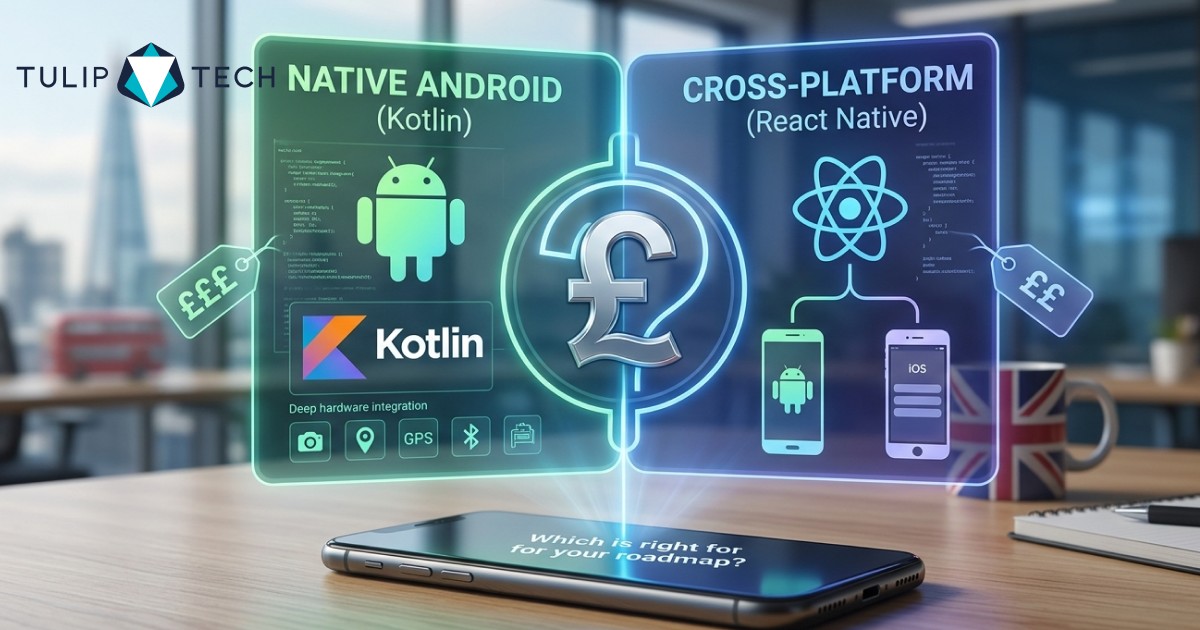
Native Android development builds specifically for the platform in Kotlin, using Android's own APIs directly with full access to every device feature. Cross-platform development with React Native or Flutter builds one codebase that runs on both Android and iOS, with the same team and release pipeline serving both.
Both produce commercial-grade apps and both hold a large share of the UK market. The Android app development price differs substantially between them, and the right choice depends on factors that have nothing to do with which technology sounds more advanced.
Why the UK changes the Android-first assumption
Globally, Android holds around 70 percent of mobile share, which is why so much generic advice says "build Android first." The UK inverts that. StatCounter puts UK Android and iOS at near-parity, roughly 50 percent each, and iOS users skew toward higher-spend cohorts.
So the standard "Android is the bigger market" logic is often wrong for a UK B2C revenue model. In the UK, the platform decision is a business-model decision, not a market-size one, and that reframes the whole cost question before you compare a single rate.
Five criteria that should drive your decision
Before comparing costs, the criteria that should drive the choice need to be set, because the cheapest option on paper is rarely the cheapest over three years.
Platform reach: if your users are exclusively on Android, native is a valid start; if you need both Android and iOS on one budget, cross-platform is the correct architecture, not a compromise.
Performance requirements: native delivers tighter hardware integration for real-time camera, AR, or high-frequency GPS, while for forms, catalogues, booking, and portals the difference is not material.
Roadmap and team structure: a cross-platform build is one codebase, team, and QA cycle, whereas native Android-only means building a second app from scratch when iOS joins the roadmap.
Long-term maintenance: two native codebases need two teams, and over three years the cumulative maintenance of two natives typically exceeds the cross-platform premium.
Regulated industry: healthcare, fintech, and legal carry a 10 to 20 percent premium for DPIAs, GDPR data architecture, and regulatory accessibility testing, scoped as a separate line from the start.
With those in place, here is what each approach costs and who it suits.
Native Android development: what it costs and who it suits
Native Android uses Kotlin and Jetpack Compose, giving direct access to the full API surface: camera and sensors, Bluetooth, NFC, biometrics, and the Google Play services ecosystem.
The ecosystem is large and diverse. No single Android version holds more than about 20 percent of devices, with Android 15, 14, 13, and 11 all in heavy use, so a native app must run reliably across four to five live versions. That device and version fragmentation is the cost most briefs miss, and it adds 15 to 25 percent to QA against the equivalent iOS build.
UK native Android build costs sit at:
Simple: £8,000 to £30,000, with basic UI, limited dynamic content, and minimal backend.
Standard: £20,000 to £70,000, with user accounts, a database, third-party APIs, and push notifications.
Complex: £70,000 to £180,000+, with real-time features, hardware integration, multiple user types, and extensive QA.
Native Android suits apps with genuine hardware requirements, products whose entire user base is on Android, and organisations with a native team they plan to maintain long-term. For the cross-platform picture, and how Android sits inside a multi-platform budget, the App Development Cost guide covers the full structure.
Cross-platform Android development: React Native and Flutter
React Native and Flutter are production-ready for the majority of business apps, and both now produce results indistinguishable from native for most users.
React Native uses JavaScript and React and renders native UI components, so the app feels native on each platform, and teams with web experience can often contribute with limited retraining. Flutter uses Dart and paints its own UI layer for pixel-perfect consistency, with a steeper learning curve for teams new to it.
The cross-platform Android development cost in the UK is typically 25 to 40 percent lower than the equivalent native single-platform build, and that budget covers both Android and iOS. The comparison shifts sharply when the real question is "Android only" versus "Android and iOS both":
Simple: £8,000 to £25,000 cross-platform, versus £18,000 to £60,000 for two native builds.
Standard: £25,000 to £60,000 cross-platform, versus £60,000 to £150,000 for two native builds.
Complex: £60,000 to £130,000+ cross-platform, versus £150,000 to £300,000+ for two native builds.
Cross-platform suits first commercial products, apps targeting both platforms, and teams extending reach without doubling cost. For budget-constrained or browser-first products, a progressive web app installs to the home screen and works offline with no store fees, at 40 to 60 percent below a native build.
What Android features cost
Inside any Android build, the feature list is what moves the number, which is why a brief that lists features as bullets returns wildly different quotes. These indicative UK ranges show the spread.
User accounts and authentication: £2,000 to £6,000, rising with social sign-in and biometrics.
Push notifications: £1,500 to £4,000, including segmentation and scheduling.
In-app chat or messaging: £4,000 to £10,000, depending on real-time and media support.
Payments and subscriptions: £4,000 to £12,000 per gateway, plus Play commission on digital goods.
Maps and geolocation: £3,000 to £9,000, plus usage-based map API fees.
Admin dashboard: £5,000 to £15,000, frequently underestimated because it is a second product.
Each feature has a basic and a production version, and the gap between them runs three to five times. Naming the production-level requirement in the brief is what stops a quote drifting later.
Where the cost lands across the Android build
A useful split across an Android project is discovery 5 to 12 percent, UI and UX design 12 to 20 percent, frontend 20 to 35 percent, backend 25 to 40 percent, QA 10 to 20 percent, and deployment 2 to 5 percent.
The backend share surprises founders who picture Android cost as screens. For any app with accounts, data, or real-time features, the server side is often the largest single line, and on Android the frontend share carries the fragmentation tax on top. Knowing the split lets you read a quote and see whether QA has been quietly compressed to hit a headline number.
What Android apps cost by sector
The complexity band is a starting point; founders usually want the figure for their kind of product. UK Android ranges by sector run roughly as follows.
Field service or logistics: £40,000 to £120,000, with scheduling, an engineer app, and live tracking.
Retail or ecommerce: £35,000 to £90,000, with catalogue, payments, and order management.
Hospitality or booking: £30,000 to £80,000, with availability, payments, and notifications.
Healthcare or fitness: £50,000 to £130,000, with the regulated premium and data-handling controls.
Each sector carries its own core features and compliance load, which is what shifts the range, not the Android platform itself.
The full Android app development cost: what the quote leaves out
The build cost in the proposal is not the total cost of ownership. Several Android-specific lines sit outside it.
Play registration, commission, and the Data Safety declaration
Google Play registration is a one-time $25 USD fee, far smaller than the development cost. The larger ongoing cost is commission: Google takes 15 to 30 percent of in-app purchase and subscription revenue, with 15 percent on the first $1 million a year. For a product earning £8,000 a month, that is £1,200 to £2,400 a month before any other cost, so build it into revenue projections.
Before launch, the Play Console now requires a Data Safety declaration auditing how every third-party SDK handles user data. For a UK GDPR-bound app that is real engineering and legal time, and it is a line almost no quote names.
The Target API Level treadmill
Google raises the minimum Target API Level every year, and apps that miss it get hidden from new-device Play listings. An app that was "finished" therefore needs a compliance sprint each year just to stay discoverable.
This is an Android-specific recurring cost that iOS does not impose the same way. Fold it into the maintenance budget as a predictable annual line, not a surprise.
Maintenance, hosting, and the UK R&D credit
Annual maintenance runs 15 to 25 percent of build cost, covering bug fixes, OS compatibility, security patches, and small features. Hosting runs £100 to £500 a month for a simple app and £2,000 to £8,000 for a high-volume one.
Against those costs, most UK Android builds qualify for R&D Tax Relief. The merged scheme gives a 20 percent above-the-line credit on qualifying spend, worth roughly 15 to 20 percent in net cash, so a £60,000 build can return around £9,000 to £12,000. The gov.uk guidance on Corporation Tax R&D relief sets out what qualifies.
Device fragmentation: scoping QA to the phones your users carry
"Android is fragmented" is a truism; the useful version is knowing where the QA budget actually goes. The cost concentrates on the OEM skins your UK users carry, led by Samsung One UI, then Google Pixel's near-stock Android, then Xiaomi and Motorola.
That means a QA budget should be weighted to real UK device share, not a generic 20-device matrix. Add foldables such as the Samsung Galaxy Z range and Wear OS companion apps, both of which bring adaptive-layout and extra test surface, and fragmentation becomes a scoped, controllable line rather than a vague surcharge.
In one anonymised UK retail build, weighting the test matrix to the client's actual analytics, which showed 70 percent Samsung and Pixel, cut the QA estimate by a fifth against the agency's default device list, with no real-world coverage loss.
Team location and what it does to the number
Where the team sits is the largest single lever on Android cost. UK developers run £500 to £625 per day median per ITJobsWatch, regional agencies £350 to £550, and London senior teams £600 to £900. Eastern European nearshore runs £28 to £60 per hour, and South Asian offshore £20 to £40.
The day-rate gap is real, but the project-cost gap is smaller, because lower-cost teams usually need more management, more discovery, and more rework. We have seen offshore Android builds land 20 to 35 percent cheaper on a tight spec, and more expensive when the spec was loose. The deciding factor is brief clarity, not the rate.
How to choose, and what to verify before signing
The decision comes back to the five criteria, in order of which risk dominates your project. If reach across both platforms matters, cross-platform wins on cost and maintenance.
If genuine hardware performance is the point, native earns its premium. If iOS is on the roadmap within twelve months, starting native rarely pays.
Whichever route you choose, verify three things before signing. IP ownership of code, design, and documentation must be assigned to you in writing, because many offshore agreements default to the agency keeping it.
An NDA should be signed before any confidential detail is shared. And you should speak to two former clients with Android apps live in your sector, because a portfolio of screenshots is not a reference.
What to prepare before you brief an Android agency
A prepared founder saves 15 to 25 percent on the total. Walk in with a written summary of what the app does and for whom, a feature list split into must-have and later, and your real user device analytics if you have them, because they scope the QA matrix.
Add a named integration list with API documentation, a confirmed budget range with a walk-away maximum, and your platform-roadmap intent for iOS. That last point alone decides whether the native-versus-cross-platform maths favours one approach or the other, and it is the question most briefs leave unanswered.
Bringing it together
Android app development cost in the UK is shaped first by the native-versus-cross-platform decision, then by feature ambition, sector, and team location. The cheapest quote is rarely the cheapest project once fragmentation QA, the annual Target API sprint, and Play commission are counted.
Decide the architecture against your roadmap, scope QA to the devices your users actually carry, and claim the R&D relief most teams forget. If you want a second read on the native-versus-cross-platform call for your specific product, our mobile app development team scopes Android builds for UK businesses across both routes.
Frequently Asked Questions
How much does Android app development cost in the UK?
A simple native Android app costs £8,000 to £30,000, a standard one £20,000 to £70,000, and a complex build £70,000 to £180,000+. A cross-platform build covering both Android and iOS typically lands 25 to 40 percent below two separate native apps at the same feature set.
Is native Android or cross-platform cheaper?
Cross-platform is cheaper when you need both Android and iOS, because one codebase covers both at 25 to 40 percent less than two native builds. Native is justified when the app depends on hardware performance or the entire user base is on Android with no iOS on the roadmap.
How much does it cost to publish an Android app?
Google Play registration is a one-time $25 USD fee. The larger ongoing cost is Play commission, which takes 15 to 30 percent of in-app purchase and subscription revenue, with 15 percent on the first $1 million a year. Registration aside, publishing cost is minimal next to development.
Why is Android QA more expensive than iOS?
Android runs across four to five live OS versions and many OEM skins such as Samsung One UI and Xiaomi MIUI, so the test matrix is wider, adding 15 to 25 percent to QA. Weighting the matrix to the devices your UK users actually carry keeps that cost controllable.
Do Android apps qualify for UK R&D Tax Relief?
Most do, where the build resolves genuine technical uncertainty. The merged R&D scheme gives a 20 percent above-the-line credit, worth roughly 15 to 20 percent of qualifying spend in net cash, so a £60,000 build can return around £9,000 to £12,000. Document the technical work as you go.