You have a product idea that will not leave you alone. Customers keep asking for it, or a spreadsheet you built for your own team has started to look like something other people would pay for every month.
So you ask what it takes to build a SaaS app, and the answers do not agree. One developer quotes twelve weeks, an agency quotes nine months, a forum says use no-code, and a CTO friend warns it will not scale past your first hundred customers.
Here is the version that settles it. You will see the full SaaS development life cycle, the architecture choices that decide whether you scale or stall, what the build really costs in the UK, how AI is changing it, how to fund it, and the compliance you cannot skip. By the end you will know how to build a SaaS app without learning the expensive lessons first hand.
What a SaaS application actually is, and why UK firms keep building one
So what is a SaaS application, exactly? It is software your customers use over the internet and pay for on a subscription, rather than buying once and installing. One codebase serves everyone, and a fix you ship on Tuesday reaches every customer by the afternoon.
That single difference shapes everything else. Because one system serves many paying customers at once, the early choices about data, security, and scale carry far more weight than they would in a one-off internal tool.
The UK demand is not in doubt. IMARC values the UK SaaS market at around 18.5 billion US dollars in 2025, rising toward 54.7 billion by 2034, and the UK has the second-largest base of SaaS companies in the world after the US. For a UK founder, buyers already expect to rent software, not own it, so the question is not whether to build but how the work unfolds from idea to live product.
Horizontal versus vertical SaaS
SaaS is not one thing. Horizontal SaaS solves a general problem for any business, such as email or accounting, while vertical SaaS solves a deep problem for one industry, like software built only for dental practices or law firms.
The split shapes how you build and sell. Vertical products win on depth and face less competition; horizontal products win on reach but fight harder for attention. Knowing which one you are building shapes every later decision, from features to pricing.
The SaaS development life cycle, phase by phase
Every product moves through the same six phases, whether you build it in twelve weeks or twelve months. Skip a phase and it returns later as rework, usually at the worst possible time.
Phase one: discovery and validation
This is where you prove the problem is real before you write code. Around 42 percent of startups fail because there was no market need, according to CB Insights, and that outcome is almost always set in motion here.
Discovery is short and cheap next to what it saves. Most discovery and scoping work runs two to four weeks and, for a commercial product, costs roughly £5,000 to £12,000, producing a validated problem, early user research, and a feature list ranked by what matters.
Phase two: design and prototyping
Now you design the experience and test it before committing to a full build. Wireframes become clickable prototypes, and a proof of concept answers the narrower question of whether the riskiest part can be built on the stack you have chosen.
This is the cheapest place to be wrong. Changing a screen in a prototype takes an hour, while changing it after launch touches code, tests, data, and every customer already using the product.
Phase three: building the MVP
An MVP is the smallest version that delivers real value to a paying user. It is not a rough draft; it is the core promise of your product, built properly, with everything optional stripped out.
Build the MVP first, every time. It puts a real product in front of real customers in two to four months instead of a year, and it tells you what to build next based on use, not opinion.
Phase four: full development
With the MVP validated, you build out the product. Frontend work shapes what the user sees, while backend work handles the logic, the data, and the rules that keep many customers safely apart on one shared system.
Integrations matter more in SaaS than first-time founders expect. Customers assume your product will connect to the tools they already pay for, so payment, email, analytics, and identity services are part of the build, not an afterthought.
Phase five: testing, security, and compliance
Quality assurance runs alongside development, not after it, because the later a defect is found the more it costs to fix. Security is not a step you bolt on at the end either: for a UK product handling personal data, compliance work starts during the build.
Phase six: launch and continuous delivery
Launch in SaaS is a beginning, not a finish line. A CI/CD pipeline lets you ship small changes safely and often, so the product improves every week rather than every release cycle, and the work shifts to retention and iteration against how customers actually use it.
Choosing an architecture that scales instead of stalling
The architecture decisions in saas platform development are the ones founders regret most when they get them wrong. They are cheap to choose well at the start and brutally expensive to change at scale.
Single-tenant versus multi-tenant
Single-tenant means each customer gets a separate instance and database, while multi-tenant means many customers share one application kept apart in software. Most products are multi-tenant because it is far cheaper to run and update.
Multi-tenancy comes in three shapes: a separate database per tenant, a shared database with separate schemas, or a single shared schema where every row carries a tenant identifier. A regulated enterprise buyer may demand a separate database, while a high-volume consumer product usually wants the shared model for cost and simplicity, so the right choice depends on your customers, not fashion.
Monolith versus microservices
A monolith is one connected codebase; microservices split the product into small independent services. The honest advice for most new products is to start with a well-structured monolith.
Microservices solve scaling problems you do not have yet. We have watched early teams burn their runway maintaining ten services for a product with two hundred users, so split the monolith only when one part genuinely needs to scale on its own.
Designing for the load you will have
Scale is a design habit, not a late rescue. Read replicas, caching, and asynchronous processing are far cheaper to plan for early than to retrofit under a live outage.
A useful rule is to design for the load you expect in eighteen months. Build only for today and you rebuild constantly; build for a million users on day one and you burn cash you do not have.
Picking a tech stack that will not box you in
The stack you pick should be boring in the best sense. Proven, well-documented tools mean you can hire for them and fix them fast, and novelty is a cost you pay every time something breaks at 2am.
React and Vue.js are the common frontend choices because the talent pool is deep and the component model suits data-heavy dashboards. On the backend, Python, Node.js, .NET, and Java all run serious products, and PostgreSQL has become the sensible database default because it supports the row-level controls that keep multi-tenant data separated. Your SaaS runs on AWS, Azure, or Google Cloud from day one, and some parts, payments, billing, authentication, and email, are solved problems best handled by specialist services so your team builds only what makes you different.
The features every SaaS product needs from day one
Whatever you are building, a few features are not optional. Accounts with role-based access control come first, and in a multi-tenant product this is also the safety feature that stops one customer ever seeing another's data.
Recurring billing with self-service upgrade and invoicing is the engine of the business model and belongs in the first version. An admin dashboard with basic analytics lets you watch sign-ups, usage, and churn, and an open API matters more than founders expect, because the moment a customer asks your product to talk to theirs, the ones without an API lose the deal.
How AI is changing the way you build and run SaaS
AI has moved from a feature you might add to a force reshaping the build itself, and any 2026 SaaS plan that ignores it is already dated. It changes both how fast you build and what the product does.
On building, AI coding and design tools genuinely compress timelines, with industry estimates suggesting 20 to 30 percent lower build cost and meaningfully faster first-draft code, though the gains shrink on complex, novel work and still need senior review. On the product, customers increasingly expect AI features as standard: in-app assistants, smart search, and predictive insights.
Build the AI feature on an off-the-shelf model first and validate the value before investing in custom training, because the running cost of a model scales with usage and belongs in your five-year numbers. The governance matters as much as the model, so budget for explainability, audit logging, and data handling, especially if the AI touches customer data or decisions.
What it costs to build a SaaS app in the UK
There is no single price, and anyone who quotes one without questions is guessing. Cost tracks scope, complexity, and who does the work, and the ranges below are UK benchmarks for custom saas app development.
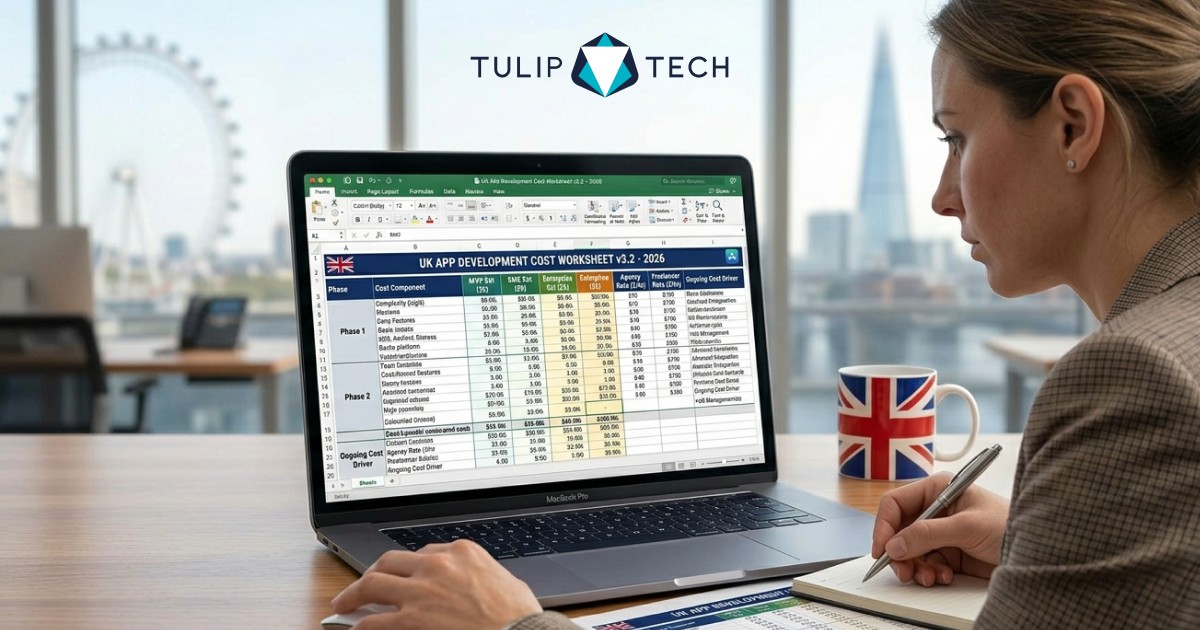
A simple, single-purpose MVP typically runs £10,000 to £30,000, a standard product with several features and roles £30,000 to £80,000, a complex multi-role platform £70,000 to £150,000, and a full enterprise system £150,000 and up. Two costs get left out of optimistic quotes: project management at 10 to 15 percent of the total, and discovery at £5,000 to £12,000 before the build begins.
Maintenance is the one founders most underestimate, at 15 to 25 percent of build cost every year. Judged over five years, a £60,000 build can carry £45,000 to £75,000 in maintenance and rising hosting, so the true cost of ownership often doubles the headline figure. The biggest lever for lowering it is phasing: build a focused MVP, put it in front of paying users, and let real demand decide what you fund next.
Where you build, and the rate trade-off
Geography matters, but less than founders hope. A UK agency typically charges £350 to £550 a day regionally and more in London, a nearshore Eastern European team roughly £28 to £60 an hour, and a South Asian team £20 to £40 an hour. The saving is real in every case, but only if the brief and oversight are tight enough to avoid rework, which is what erases the difference on a loose spec.
The SaaS metrics and benchmarks that tell you it is working
A SaaS business lives and dies by a handful of numbers, and knowing the benchmark for each turns a dashboard into a decision tool. Monthly and annual recurring revenue show the income you can count on, while customer acquisition cost and lifetime value show whether each customer is worth winning.
Churn is the metric that quietly kills products, and a healthy SaaS keeps annual customer churn below 5 percent, with median net revenue retention near 106 percent for venture-backed SaaS according to ChartMogul. Two investor benchmarks are worth knowing: the Rule of 40, where growth rate plus profit margin should exceed 40 percent, and gross margins, which for a healthy SaaS sit around 70 to 85 percent. CAC payback, the months it takes to recover the cost of winning a customer, should ideally sit under twelve for an efficient business.
Running the product after launch: observability and cloud cost
Launch is where the running discipline starts, and two operational areas decide whether a growing SaaS stays healthy or quietly bleeds money. The first is observability: logging, monitoring, and alerting that tell you a tenant is struggling before they email you, which is far cheaper than losing them to a problem you never saw.
The second is cloud cost management, often called FinOps. Cloud bills grow with usage, and without active management a successful SaaS can watch its margin erode as it scales, so tracking cost per tenant and right-sizing infrastructure is a continuous job, not a one-off. Tenant onboarding also belongs here, because a smooth, partly automated onboarding is what lets you add customers without adding support headcount at the same rate.
Pricing your SaaS so it actually makes money
Pricing is part of the saas product development process, not a decision you bolt on at launch. The model you choose shapes what you build, who you sell to, and whether the numbers ever work.
Most products use a blend of proven models: tiered good-better-best packages, usage-based pricing that charges for consumption, per-user pricing by seat, and freemium or free trials that lower the barrier then convert a share to paid. Usage-based pricing is associated with faster revenue growth because the bill grows as the customer succeeds, and most mature products end up blending two or three models. Winning a customer is the expensive part; a strong onboarding that reaches real value in the first session does more for retention than any discount.
That acquisition cost is also where most early budgets go. Founders without an in-house growth team often run paid channels through a digital marketing agency, which can shorten CAC payback when targeting and creative are handled by specialists.
How UK founders fund a SaaS build
Most SaaS guides stop at the price and ignore where the money comes from, but for a UK founder the funding route changes the maths. Three sources are worth knowing before you commit.
The Seed Enterprise Investment Scheme lets angel investors claim generous income-tax relief on early-stage investments, which makes a pre-seed round far easier to fill, and EIS extends similar relief to larger follow-on rounds. Securing advance assurance from HMRC before you raise reassures investors the relief will apply. Alongside equity, R&D tax relief offsets part of the build, and many founders combine an SEIS round with a later R&D claim to stretch the runway.
The exact SEIS and EIS limits shift with each reform, so confirm the current figures on gov.uk before you raise. The point for planning is that the UK tax-advantaged capital stack is real money most founders leave on the table.
The UK tax relief most founders miss, and the trap in it
Building genuinely new software can qualify for R&D tax relief, and most founders underclaim it. Under the merged R&D Expenditure Credit scheme, qualifying development earns a 20 percent above-the-line credit, worth around 15 percent net to a profit-making company, with loss-making R&D-intensive startups able to claim more through Enhanced R&D Intensive Support, per gov.uk.
The trap is assuming all development qualifies. It does not, and HMRC increasingly rejects claims for routine SaaS work.
Building standard CRUD features on mainstream frameworks is not R&D; resolving genuine technological uncertainty, such as novel multi-tenancy at scale or a hard performance problem, is. Claim on the work that genuinely advances the field, document the uncertainty as you go, and you have a defensible claim rather than a rejected one.
The security and compliance you cannot skip in the UK
Security is where saas web application development gets serious in the UK, because you are holding other people's data on shared infrastructure, and a breach is a legal, financial, and reputational event at once.
UK data protection and data residency
If your SaaS handles personal data, UK GDPR and the Data Protection Act 2018 apply from your first user. Build privacy in from the start, because data minimisation, clear consent, and the ability to export or delete a customer's data are far cheaper to design in than to retrofit after an audit.
Where the data physically lives is its own decision. UK and EU buyers, especially in the public sector and regulated industries, increasingly require data residency in a UK or EU cloud region, and that requirement interacts with your multi-tenancy design, so settle it before you provision the first environment.
The standards buyers will ask about
Business customers increasingly will not buy without proof you take security seriously. ISO 27001 and Cyber Essentials are the UK standards buyers recognise, and SOC 2 matters if you sell to North American firms. These force the access controls, monitoring, and incident planning that keep a multi-tenant SaaS safe, and they shorten enterprise sales cycles because the buyer's security team has fewer questions.
The global average cost of a data breach reached 4.88 million US dollars in 2024 according to IBM, and in a subscription business the customers who leave after a breach take their recurring revenue with them.
Selling a UK SaaS into enterprise and the public sector
Building the product is half the job; becoming sellable into UK organisations is the other half, and it shapes the build. UK enterprise buyers treat Cyber Essentials and ISO 27001 as procurement gates, so the certifications above are sales tools, not just security ones.
Selling to UK government adds another route: the G-Cloud framework on the Digital Marketplace is how public-sector buyers procure SaaS, and listing there requires security and data-handling evidence prepared in advance. Building the documentation, the data-processing agreements, and the security posture procurement teams expect is work to budget for, because the technically excellent product that is not procurement-ready sits unsold.
Where SaaS builds quietly go wrong, and how to prevent it
After enough years building saas applications, the failure patterns rhyme, and the technology is rarely the real problem. The most common mistake is building the whole vision before testing any of it, which is exactly why the MVP exists.
The second pattern is leaving scale and multi-tenancy as a later problem, which works fine with fifty users until a big customer signs and the team is rebuilding the foundations while the house is full. One client came to us with a product that worked beautifully for its first forty customers and fell over at the fiftieth, because the build used a single shared database with no tenant separation planned for scale; re-architecting it live took longer than the original build, when designing multi-tenancy in from the start would have made it a configuration change. The third pattern is bolting security on at the end, and the fourth is choosing a partner on price alone, because the cheap build that needs replacing in eighteen months is the most expensive build there is.
How to choose and brief the team that builds your SaaS
Whether you hire in-house, an agency, or a dedicated team, the right partner is the one who has shipped products like yours and survived scaling them. An in-house team gives the most control and the slowest start, an agency can begin in weeks and suits a fixed build, and a dedicated team hired through a partner sits between the two with continuity for a product that will keep evolving.
Settle two things in writing before any confidential detail changes hands: a signed NDA, and intellectual property ownership, so you own the source code, designs, and documentation at handover with no licence you must keep paying to use your own product. When you are comparing build partners specifically, our guide to SaaS development companies in the UK sets out how to evaluate them. Bring a clear brief, the problem, the customers, the must-have features, and the budget, because a build without a definition of done drifts forever.
Turning the plan into a SaaS product
Knowing how to build a SaaS app comes down to making a sequence of good decisions in the right order. Validate before you build, choose an architecture that fits your customers, fund it through the routes available to UK founders, and ship a focused MVP before the full vision.
Get those right and the build becomes manageable rather than mysterious, because the founders who succeed are rarely the ones with the biggest budget; they are the ones who spent it in the right order. If you want a partner who has done this across regulated and high-growth industries, our software development team can scope it with you before you commit.
Frequently asked questions about SaaS development
How long does it take to build a SaaS app?
A SaaS MVP usually takes two to four months to build and launch, while a full-featured platform can take a year or more. The honest timeline depends on scope, the number of integrations, and how quickly you make decisions, which is often the real bottleneck rather than the engineering itself.
How much does it cost to build a SaaS application in the UK?
A simple SaaS MVP typically costs £10,000 to £30,000, a standard product £30,000 to £80,000, and a complex platform £70,000 to £150,000 or more. On top of the build, add project management at 10 to 15 percent and yearly maintenance at 15 to 25 percent of the build cost.
Can I build a SaaS app without coding?
No-code and low-code platforms can build a working prototype or a simple internal tool quickly, but they struggle once you need custom logic, real scale, or tight control over data and security. Most commercial products move to custom development as they grow beyond their first customers.
Does a SaaS build qualify for UK R&D tax relief?
Only the part that resolves genuine technological uncertainty, such as novel multi-tenancy at scale or a hard performance problem. Routine CRUD features on mainstream frameworks do not qualify, and HMRC increasingly rejects such claims. Where it does apply, the merged scheme is worth around 15 percent net of qualifying spend.
Do I own the code if an agency builds my SaaS?
You should, but only if you agree it in writing first. A proper contract assigns the source code, designs, and documentation to you at handover, with no ongoing licence to use your own product. Always settle intellectual property and sign an NDA before you share any confidential detail.