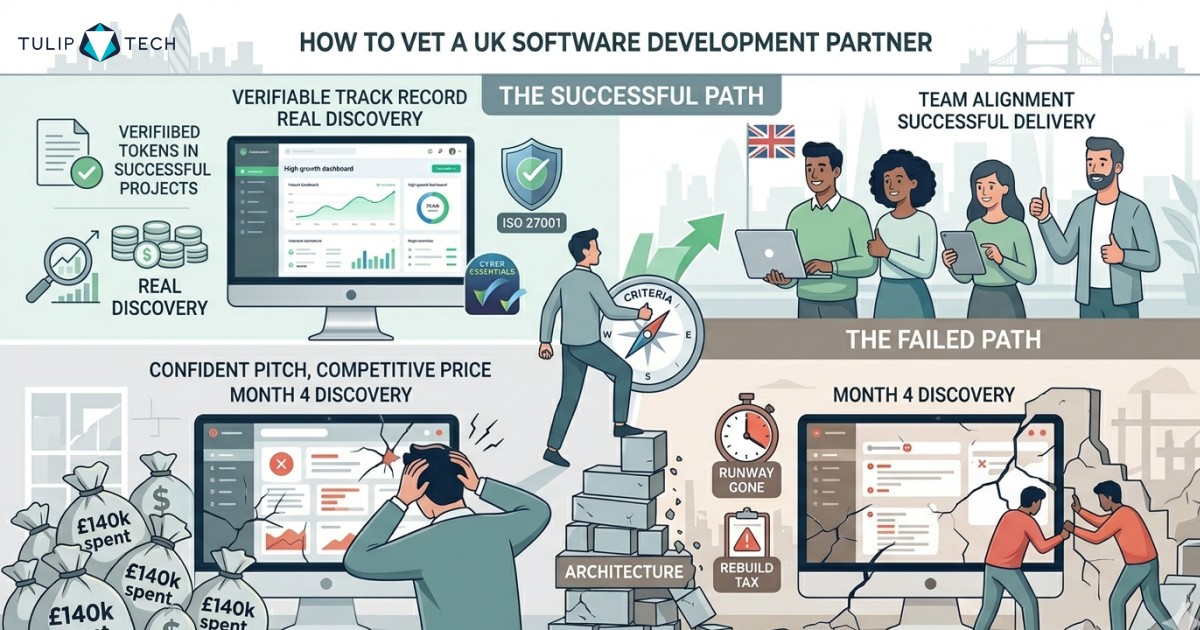
A London fintech we know spent 140,000 pounds with a development company chosen on a confident pitch and a competitive price. Eighteen months later the build was being re-architected, the runway was gone, and the founders were interviewing a second agency to fix the first one's work.
The technology was not the problem. The choice was. The company looked capable, quoted well, and could not deliver the regulated product it had promised, and none of that was visible until month four.
Choosing a software development company is the most consequential decision a buyer makes, because it sets the ceiling on everything that follows. This guide gives UK buyers the criteria that matter, the red flags that predict failure, the practical way to vet a firm before signing, and the contract terms that protect you under UK law.
Why the choice matters more than the quote
The cost of choosing the wrong company is rarely the quote; it is the rebuild. Large IT projects run on average 45 percent over budget and deliver 56 percent less value than predicted, with 17 percent so troubled they threaten the company's existence, according to McKinsey and the University of Oxford. The cause is far more often the partner and the process than the code.
A capable-looking company that has never shipped your kind of system will not see the gaps until it hits them, by which point the architecture is set and expensive to undo. The right partner is the one that has built and scaled products like yours, not the one with the lowest day rate.
The full cost picture sits in our software development cost guide; choosing who spends it is the harder half, and it starts with the criteria below.
The criteria that actually separate good from average
Most company websites compete on the same words: agile, scalable, expert, partner. The criteria below cut through that, and each deserves a yes-or-no answer rather than a soft impression.
Relevant, verifiable delivery history
Has the company shipped at least three live products like yours, and will it name them? Reference quality beats reference quantity, so ask to speak to one client with a system comparable to yours in scale and sector, not a glossy logo wall.
Cross-check the claims against third-party review platforms such as Clutch or GoodFirms, where reviews are verified with the client rather than curated by the agency. A firm with live, sector-relevant references and consistent independent reviews is showing you evidence, not marketing.
A real discovery process
A serious partner insists on paid discovery before quoting a build, because a fixed price on an undefined scope is a guess. If a company quotes a full build from a one-page brief without proposing discovery, it is pricing its cheapest assumption, which you will renegotiate later.
Good discovery ends with something you own: a scoped requirements document, an architecture outline, and a realistic estimate. That deliverable is worth paying for even if you do not proceed, because it turns a vague idea into a brief any partner can quote against.
Team stability and a named lead
Ask who actually builds your product and whether that team stays for the duration. A proposal that names a senior team in the pitch and staffs juniors after signing is the oldest trap in the trade, so require a named delivery lead with accountability written into the contract.
Ask too whether any of the work is subcontracted, and to whom. A chain of subcontractors dilutes accountability and muddies the IP trail, and you want to know that before a problem appears, not after.
Security and certification maturity
For any system handling data, ISO 27001 and Cyber Essentials are signals of genuine information-security practice, not box-ticking. Very few UK firms hold both, so requiring them instantly narrows the field to companies that treat security as a discipline rather than a badge.
Transparent pricing and assumptions
Read the assumptions behind the number, not just the number. A credible proposal states what it has assumed about scope, integrations, and data, names project management as a line at 10 to 15 percent, and includes a contingency. A quote with none of that is hiding the risk until it surfaces as a change request.
Proven AI capability, used with discipline
AI now sits inside the build, not beside it. Nearly 80 percent of new developers on GitHub use Copilot within their first week, according to GitHub's 2025 Octoverse report, so the question is no longer whether a company uses AI but whether it does so with discipline.
Ask how they review AI-generated code, how they keep your IP and data out of third-party models, and where a human still signs off. A partner that can answer that has thought about quality and security; one that treats AI as a magic speed-up has not.
The criteria tell you who can build. How a company talks to you tells you whether it actually will.
How they communicate is how they will deliver
The way a company communicates while it is trying to win you is the best it will ever communicate. Watch response times, the clarity of plain-English answers to technical questions, and whether the people who will build the product are in the room or hidden behind a salesperson.
Agree the working rhythm before you sign: who you speak to, how often, and through which channel. A weekly demo, a named point of contact, and direct access to the delivery team matter more than a polished account manager who relays messages.
Cultural and time-zone fit belong here too. A partner four or five hours ahead can still work well with a defined overlap window and asynchronous updates, but only if both sides agree the cadence up front rather than discovering the gap mid-sprint.
Good communication is the wrapper. The process underneath it is what ships your product.
The development process and quality assurance
Ask how a company turns your requirements into working software, because the method decides how change is handled. Most capable firms run an agile process in two to four-week sprints, with a review and a re-plan at the end of each one, so priorities can shift without a contract renegotiation.
Quality assurance is the part buyers forget to ask about and regret later. Confirm there is dedicated testing, automated where it counts, and a definition of done that includes QA rather than treating it as an optional final step.
Find out how requirements are documented and how scope changes are priced and approved. A partner with a clear change process protects both sides; one that waves the question away will treat every change as a surprise invoice. Ask to see a sample sprint report or board from a recent project, because a firm that runs a real process can show you one in minutes.
Process and people both look good on a call, so the next step is to verify the firm before you sign.
How to vet a UK software company before you sign
Everyone says check their track record; almost no one says how. For a UK firm, the checks are concrete and free, and skipping them is how buyers end up with the wrong partner.
Check Companies House to confirm the company's trading history, registered address, and that its filings are up to date, because a firm pitching a six-figure build should not have overdue accounts. Check the ICO register to confirm it is registered as a data controller, which it must be to handle personal data lawfully. Verify any Cyber Essentials or ISO 27001 claim against the certifying body's register rather than trusting a badge on the website.
Then verify the people and the work. Confirm the named delivery lead exists and has the experience claimed, read independent reviews on Clutch or Google, and speak to two former clients with live systems in your sector. Fifteen minutes of these checks routinely surfaces what a polished pitch hides.
The same checks also expose the warning signs that predict a failed build.
The red flags that predict a failed build
Most software project disasters look obvious in hindsight, so learn to read the warning signs at the time. Any one is a question to ask; three or more is a reason to walk away.
A fixed-price quote for a full build with no discovery proposed signals an agency that will renegotiate at month three. A proposal with no assumptions section is hiding the scope risk. A large agency pitching a small project is an operating-model mismatch that usually means junior staffing and slow turnaround.
A company that claims its projects rarely overrun is either inexperienced or not being straight, because every honest delivery lead manages overrun risk openly. Reluctance to sign an NDA before discussing confidential requirements, or to assign IP at handover, tells you the firm is protecting its position over yours. And a budget quietly revised down to hit an arbitrary number you mentioned is a firm cutting quality to win the deal.
Two of those red flags are about contracts, which is where UK buyers lose the most without realising it.
IP ownership and NDA: the contract terms UK law makes essential
This is where UK buyers most often sign away the rights to software they paid to build. Under the Copyright, Designs and Patents Act 1988, code commissioned from an external company belongs by default to the developer, not to you, unless it is assigned to you in writing.
That makes the IP clause non-negotiable. Require a present-tense assignment of all intellectual property, source code, design assets, and documentation to your company on payment, not a vague promise to assign later or a perpetual licence to use your own product. A firm that resists is anchoring you for future revenue.
The NDA is separate and earlier. It protects the confidential requirements you share during evaluation, before any build IP exists, and a reputable company signs one on the first call. Treat the NDA and the IP assignment as two distinct protections, because conflating them leaves a gap a careless or opportunistic partner can exploit.
Contracts decide who owns the work. The pricing model decides who carries the risk of building it.
Pricing models and who carries the risk
The pricing model decides who absorbs the uncertainty, so choose it for your situation rather than the company's preference. A fixed-price contract gives cost certainty but prices in a risk premium and makes every change a separate negotiation, suiting only a fully defined scope.
Time and materials transfers budget risk to you but is cheaper when scope is clear and you can monitor progress. The middle ground experienced buyers use is a fixed-price discovery that defines the scope, followed by a capped or milestone-based build against it, which de-risks both sides.
When the stakes are high, start with a small paid pilot before committing the full budget, since one real sprint reveals more than any reference call. Where the work resolves genuine technical novelty, factor in UK R&D tax relief, which can return a meaningful share of qualifying development spend and lowers the effective cost of the engagement.
Whatever the model, the engagement does not end at launch, and the best partners price for what comes after.
What happens after launch: support, maintenance, and handover
A build is not finished when it ships; it enters the phase where it earns or costs money. Ask what support looks like after go-live, what response times are guaranteed, and whether maintenance is a defined service or an afterthought.
Annual maintenance typically runs 15 to 25 percent of the build cost, so a partner with no answer on it has not planned for the product's real life. Confirm the service level: how fast critical issues are fixed, who is on call, and how updates and security patches are handled.
Insist on a clean handover even if you intend to stay with the same partner. The source code in a repository you control, current documentation, and a knowledge transfer session mean you are never held hostage by the only people who understand your system. For a business-critical system, a source code escrow arrangement adds a further safeguard, releasing the code to you if the supplier fails or folds.
How heavily each of these factors weighs depends on where your business is in its journey.
How the right choice changes by your stage
The best partner for a pre-seed startup is not the best partner for an enterprise, so weight the criteria to your situation. An early-stage founder should favour speed, a focused MVP, and a partner comfortable with phased delivery, keeping scope tight and runway long.
A funded scale-up should weight architecture, team stability, and the ability to scale the system and the team together, because the build becomes the production product. An enterprise or regulated buyer should lead with certifications, references in the same sector, and the security and procurement evidence those deals demand.
Matching the partner to the stage is what turns a generic shortlist into the right decision, and it leaves only the final call.
The questions to ask before you sign
Run this set on the final call with each company, and treat hesitation on three or more as a signal.
Can you name three live products like ours and let us speak to a client? What is your discovery deliverable, and what does it cover? Who is the named delivery lead, and does the team stay for the project?
How do you run sprints, testing, and change requests? Which certifications do you hold, and which apply to our data? Is project management a named line at 10 to 15 percent?
Does the contract assign full IP to us at handover, and will you sign an NDA before we share requirements? What do support and maintenance cost after launch, and where will our data be hosted? A company that answers these in plain English, without escalating to a salesperson, is one that has done this before.
Their answers give you the raw material. The final step is comparing it fairly.
How to compare your shortlist without bias
Three good companies will all interview well, so the final choice needs a method, not a gut feel. Score each firm against the same criteria, weighted for your stage, rather than reacting to whichever pitch was most recent or most polished.
Give each criterion a simple weight and mark, then treat the contract and post-launch terms as pass-or-fail gates rather than scores, because no amount of charm offsets a firm that will not assign your IP. Rank the totals, and where two firms tie, let the reference calls and the paid pilot decide.
Write the decision down with the reasons beside it. A short scoring note protects you later, both as a record for the board and as a check against the confident pitch that quietly moved your budget.
With the scores in front of you, the decision is evidence rather than impression.
Making the decision with confidence
Choosing a software development company comes down to evidence over impression: verifiable delivery, a real discovery process, security maturity, transparent pricing, clear communication, and contract terms that protect your IP under UK law. Vet the firm with the free checks available, read the assumptions behind the quote, and weight the criteria to your stage.
The cheapest quote is rarely the cheapest project, because the rebuild that follows a wrong choice costs more than getting it right the first time. If you want a UK partner with ISO 27001 certification, transparent pricing, and IP assigned on payment, our software development team is glad to be one of the companies you compare.
Frequently Asked Questions
How do I choose a software development company in the UK?
Judge on verifiable delivery history, a real discovery process, team stability with a named lead, security certifications, and transparent pricing with stated assumptions. Then vet the firm through Companies House, the ICO register, and the certifying body for any Cyber Essentials or ISO 27001 claim, and speak to two reference clients in your sector.
Who owns the code when a company builds my software?
Under the UK Copyright, Designs and Patents Act 1988, commissioned code belongs to the developer by default unless it is assigned to you in writing. Require a present-tense IP assignment of source code, designs, and documentation to your company on payment, not a promise to assign later or a licence to use your own product.
What are the red flags when choosing a development company?
A full build quoted with no discovery, a proposal with no assumptions section, a large agency pitching a small project, claims that projects rarely overrun, reluctance to sign an NDA or assign IP, and a budget revised down to hit your number. One is a question to ask; three or more is a reason to walk away.
Should I choose a UK or offshore software company?
A UK or UK-led partner suits unclear-scope work, regulated systems, and projects needing close collaboration. Offshore and blended models lower cost on well-defined builds with strong management. If you go offshore, insist on a named hosting region, a signed Data Processing Agreement, and clarity on data access under UK GDPR.
What questions should I ask a software development company?
Ask for three live reference products you can verify, the discovery deliverable, the named delivery lead, how they run sprints and testing, the certifications that apply to your data, whether PM is a named line, whether the contract assigns full IP at handover, and what support costs after launch. Plain-English answers without a sales escalation are the signal you want.
What should I expect for support after launch?
Treat support as part of the decision, not an afterthought. Expect annual maintenance to run around 15 to 25 percent of the build cost, a defined service level for critical fixes, and security patching as standard. Insist on a clean handover too: source code in a repository you control, current documentation, and a knowledge transfer session.