You need an iPhone app, and the quotes in front of you do not agree. One is half the other for what looks like the same product, and nothing in either document explains the gap.
iOS app development cost in the UK is not a single number. It is built from the platform you target, the features you choose, the team you hire, and a set of Apple-specific costs that most quotes leave out entirely.
This guide maps every one of those lines: the cost bands, the per-feature ranges, where the money lands by phase, and the App Store, privacy, and hardware costs competitors rarely mention.
What iOS development actually involves
Native iOS development uses Swift, Apple's modern language, with SwiftUI or UIKit for the interface. The choice between those two frameworks is a genuine cost lever, not a technicality.
SwiftUI is faster to build in and needs fewer hours for standard interfaces, which lowers cost on most new apps. UIKit is still needed for complex custom interfaces and older codebases, and a mixed SwiftUI-and-UIKit build costs more than either alone because the team maintains two interface models.
iOS also gives deep access to Apple hardware and services: Face ID and Touch ID, Apple Pay, HealthKit, ARKit, and the Watch and CarPlay ecosystems. Each of those is a feature that adds cost when you use it, which is why the brief, not the platform, decides the final number.
What iOS app development costs in the UK
These figures sit inside the wider App Development Cost guide, which maps how iOS compares with Android, cross-platform, and web builds.
The headline iOS ranges sit at three levels of complexity. Use them as anchors, then read the per-feature and per-phase sections to narrow the figure.
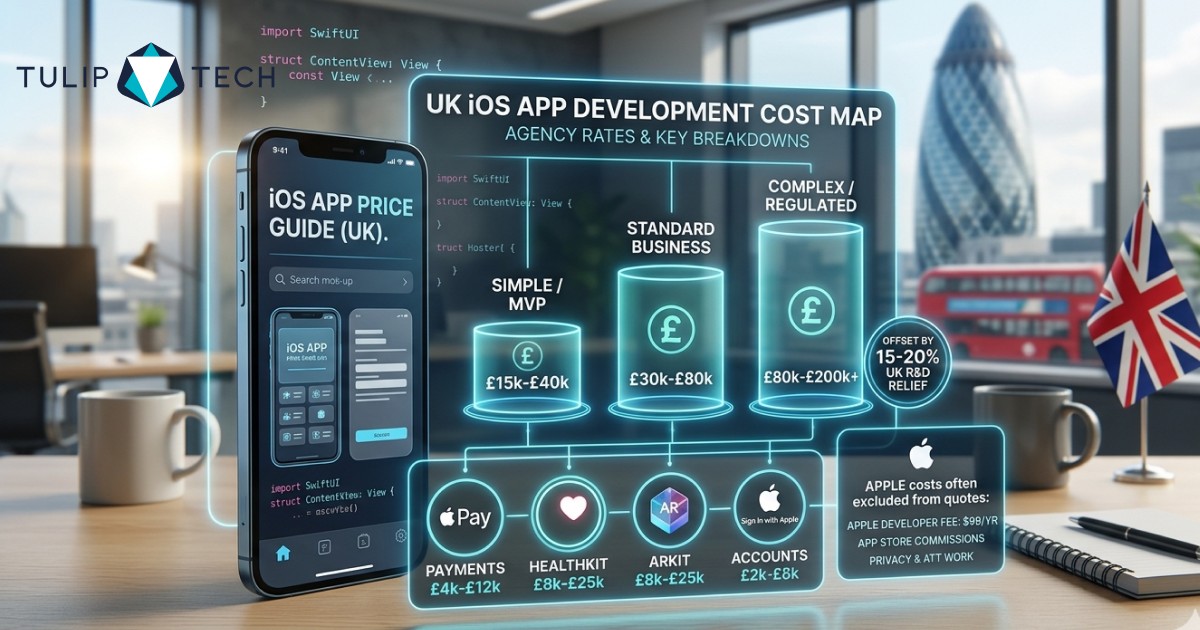
Simple iOS app or MVP: £15,000 to £40,000, with three to five core features in 8 to 12 weeks.
Standard business app: £30,000 to £80,000, with accounts, a backend, and integrations in 12 to 20 weeks.
Complex or regulated product: £80,000 to £200,000+, with real-time data, hardware integration, or compliance work over five months or more.
These are commercial UK ranges at agency rates. The figure moves most with feature ambition and the regulated-industry premium, both covered below.
What iOS features cost
Inside any iOS build, the feature list is what moves the number, which is why a brief that lists features as bullets returns quotes that differ by tens of thousands. These indicative UK ranges show the spread.
User accounts and Sign in with Apple: £2,000 to £6,000, rising with social sign-in and biometrics.
Apple Pay and in-app purchases: £4,000 to £12,000, plus Apple's commission on digital goods.
Messaging or chat: £4,000 to £12,000, depending on real-time and media support.
Maps and location: £3,000 to £9,000, plus usage-based map API fees.
HealthKit or ARKit integration: £8,000 to £25,000, where the hardware and data handling add real depth.
Admin dashboard: £5,000 to £15,000, often underestimated because it is a second product.
Each feature has a basic and a production version, and the gap between them runs three to five times. Naming the production-level requirement in the brief is what stops a quote drifting later.
Where iOS cost lands by phase
An iOS build does not split cost evenly. A useful breakdown is discovery 7 to 12 percent over two to four weeks, design 12 to 18 percent over three to six weeks, build 45 to 55 percent over 8 to 16 weeks, QA 10 to 15 percent over three to five weeks, and submission 2 to 5 percent over one to two weeks.
The build is the bulk, but discovery and QA are where rushed projects fail. Skipping discovery on iOS is doubly costly, because App Store rejection late in the cycle, covered below, sends you back through a review queue you cannot speed up. Reading a quote phase by phase shows whether QA and submission have been quietly compressed to hit a headline number.
What iOS apps cost by type
The complexity band is a starting point; founders usually want the figure for their kind of product. UK iOS ranges by type run roughly as follows.
Content or utility app: £15,000 to £45,000, where the value is a focused single purpose.
Ecommerce or retail app: £35,000 to £90,000, with catalogue, Apple Pay, and order management.
On-demand or booking app: £40,000 to £100,000, with availability, payments, and notifications.
Health or fitness app: £50,000 to £130,000, with HealthKit, the regulated premium, and data controls.
Social or community app: £45,000 to £110,000, with feeds, messaging, and moderation.
Each type carries its own core features and compliance load, which is what shifts the range, not the iOS platform itself.
Native iOS versus cross-platform
If you need only iOS, native Swift is the natural route. If you need iOS and Android on one budget, cross-platform with React Native or Flutter covers both at 25 to 40 percent less than two separate native apps.
Native iOS earns its premium when the app leans on Apple hardware, such as ARKit, advanced camera work, or HealthKit, or when the user base is heavily iOS and performance is the point. For most UK business apps that target both platforms, cross-platform is the more sensible spend, with the small trade-off of a short delay accessing brand-new iOS features at each September release.
The UK matters here. iOS holds close to half of UK mobile share and skews toward higher-spend users, so an iOS-first or iOS-only decision is often a revenue decision rather than a reach one.
The Apple costs most iOS quotes ignore
The build figure in a proposal is not the total. Several Apple-specific lines sit outside it, and they are where founders get surprised.
The Apple Developer Program fee
The Apple Developer Program costs $99 USD per year, roughly £79 to £82, and is required to publish to the App Store. Note the currency: it is a dollar fee, and several competitor guides wrongly quote it as £99, which overstates it. Always budget the correct figure.
App Store commission
Apple takes 30 percent of in-app purchase and subscription revenue, dropping to 15 percent for businesses earning under $1 million a year through the Small Business Program, and 15 percent on subscriptions after the first year. For any monetised app this is a permanent cost line that shapes unit economics, so model it before launch.
The Apple hardware and tooling cost
Building for iOS requires Apple hardware your team must own. Xcode runs only on macOS, so a build needs at least one Mac, and a realistic device-test matrix runs from the oldest supported iPhone to the newest, plus an iPad if the app is universal.
For an in-house team that is a real recurring cost, a Mac plus a handful of test devices, that an agency absorbs into its rate. It is worth knowing which model you are paying for.
App Store submission and the cost of rejection
Apple reviews every submission, and most apps are reviewed within 24 to 48 hours. The cost risk is not the wait; it is rejection, and a meaningful share of first submissions come back with required changes.
Common rejection reasons are predictable: missing privacy strings, broken links, misuse of in-app purchase, or guideline 4.3 spam flags. Each rejection costs calendar time in the re-review queue plus the rework itself, and on a launch tied to a funding round or a campaign, that delay has a business cost beyond the engineering hours.
App Tracking Transparency and privacy work
This is the iOS cost line almost no guide mentions. Since iOS 14.5, App Tracking Transparency requires an explicit consent prompt before tracking users across apps, and the App Store requires a privacy "nutrition label" plus a Privacy Manifest declaring how every third-party SDK handles data.
For a UK GDPR-bound app, that is real build cost: consent flows, SDK auditing, and accurate data declarations, with App Store rejection risk if it is mishandled. Budget it as a named line, because it does not build itself.
TestFlight and the beta phase
TestFlight is Apple's free beta distribution tool, supporting up to 10,000 external testers, and it is how a serious iOS launch de-risks the public release. External TestFlight builds still pass a lighter Apple review, which is why the QA and submission phase costs what it does.
A managed beta of three to four weeks through TestFlight catches the issues that would otherwise become a public rejection or a one-star launch. The tooling is free; the time to run it well is the cost.
UK rates and team location
Where the team sits is the largest single lever on iOS cost. UK developers run £500 to £625 per day median per ITJobsWatch, with London senior teams at £600 to £900 and regional UK agencies at £350 to £550. Eastern European nearshore runs £28 to £60 per hour and South Asian offshore £20 to £40.
The day-rate gap is real, but the project-cost gap is smaller, because lower-cost teams usually need more management and rework. We have seen offshore iOS builds land 20 to 35 percent cheaper on a tight specification and more expensive when the spec was loose. Brief clarity, not the rate, decides the outcome.
Ongoing iOS costs and the relief that offsets them
The launch is not the end of spend. Annual maintenance runs 15 to 25 percent of build cost, and iOS specifically demands it: each September a major iOS release can deprecate frameworks and break APIs, forcing a maintenance sprint whether or not you add features. That is why the maintenance band sits where it does.
Hosting runs £100 to £500 a month for a simple app and £2,000 to £8,000 for a high-volume one. Against those costs, most UK iOS builds qualify for R&D Tax Relief, where the work resolved genuine technical uncertainty. The merged scheme gives a 20 percent above-the-line credit, worth roughly 15 to 20 percent of qualifying spend in net cash, so a £60,000 build can return around £9,000 to £12,000, per the gov.uk guidance on Corporation Tax R&D relief.
How to choose an iOS partner and what to verify
Pick the route that matches your dominant risk: native Swift for hardware-heavy or iOS-only products, cross-platform when both platforms share one budget. Then verify three things before signing, whoever you choose.
IP ownership of code, design, and documentation must be assigned to you in writing, because many offshore agreements default to the agency keeping it. An NDA should be signed before any confidential detail is shared. And ask to speak to two former clients with iOS apps live in your sector, because App Store links are easy to verify and a portfolio of screenshots is not a reference.
Bringing it together
iOS app development cost in the UK is shaped by the framework choice, the feature set, the team location, and a set of Apple-specific costs, from the developer fee to ATT privacy work, that most quotes leave out.
Decide native versus cross-platform against your roadmap, budget the App Store and privacy lines as named items, run a proper TestFlight beta, and claim the R&D relief most teams forget. If you want a second read on the figure for your specific iOS product, our mobile app development team scopes iOS builds for UK businesses.
Frequently Asked Questions
How much does iOS app development cost in the UK?
A simple iOS app or MVP costs £15,000 to £40,000, a standard business app £30,000 to £80,000, and a complex or regulated build £80,000 to £200,000+. The figure depends on features, the regulated premium, and team location more than on the platform itself.
How much is the Apple Developer Program fee?
The Apple Developer Program costs $99 USD per year, roughly £79 to £82. It is a dollar fee, not £99 as some UK guides wrongly state, and it is required to publish to the App Store. Budget the correct figure rather than the inflated one.
Is it cheaper to build iOS only or iOS and Android together?
If you only need iOS, native Swift is the natural route. If you need both platforms on one budget, a cross-platform build covers both at 25 to 40 percent less than two separate native apps. UK iOS users skew toward higher spend, so an iOS-first decision is often about revenue rather than reach.
What hidden costs do iOS quotes leave out?
The Apple Developer fee, App Store commission of 15 to 30 percent on digital goods, App Tracking Transparency and privacy-label work, a Mac and test-device matrix, and 15 to 25 percent annual maintenance driven by the September iOS releases. None of these appear in the headline build figure.
Do iOS apps qualify for UK R&D Tax Relief?
Most do, where the build resolves genuine technical uncertainty. The merged R&D scheme gives a 20 percent above-the-line credit, worth roughly 15 to 20 percent of qualifying spend in net cash, so a £60,000 build can return around £9,000 to £12,000. Document the technical work as you go to support the claim.