
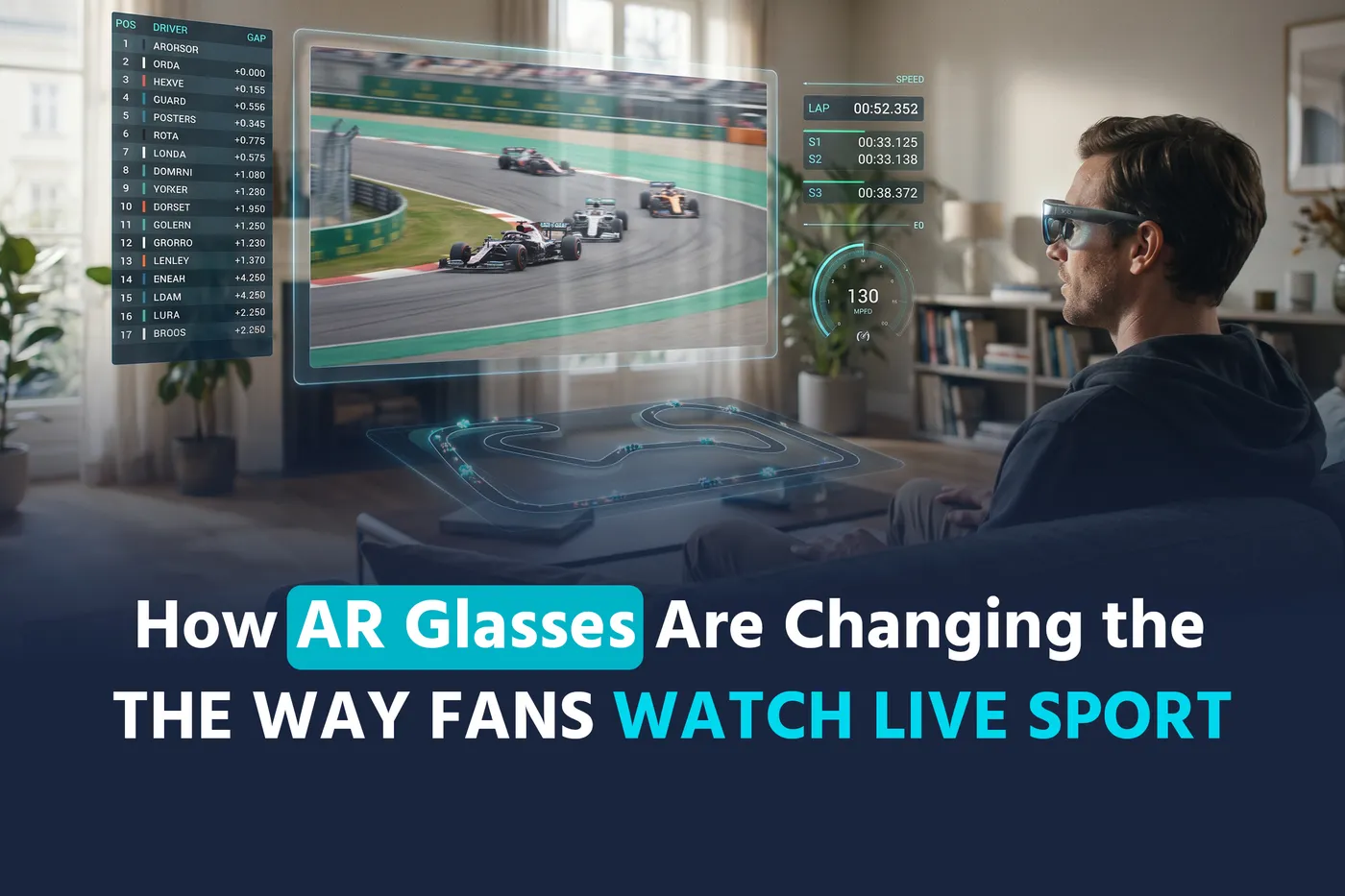
AR glasses are changing live sport by putting the broadcast, the live data and 3D views of the action into one field of view, all in sync. Instead of looking down at a phone for scores, timings or replays, fans see them beside the picture, and the room around them stays visible.
The technology is still early. Most smart glasses sold today have no display at all: display glasses made up 14.3% of XR headset and glasses shipments in Q2 2026, according to IDC. But display glasses such as the XREAL One Pro can already create a large virtual screen with data panels around it, and sports apps are starting to use that space.
We have built one. At TulipTech we developed GridSide, an AR app that turns XREAL One Pro glasses into a personal pit wall for motorsport fans. This guide covers what AR glasses can do for live sport today, what UK fans can and cannot watch on them in 2026, and what we learned building a live sports AR app.
What are AR glasses, and how are they different from VR headsets?
AR (augmented reality) glasses add digital images to your view of the real world, while VR (virtual reality) headsets replace it. For watching sport, that difference matters: with AR glasses you see a virtual screen and live data, and you can still see your room and the people you are watching with.
"Smart glasses" covers several kinds of device, and only some of them can show a match:
| Device type | Examples | What you see | Role in live sport |
|---|---|---|---|
| Display AR glasses | XREAL One Pro | A large virtual screen and floating panels through see-through lenses, driven by some limited android phones, laptop or XREAL Beam Pro | Watching the broadcast with live data around it, at home or on the move. Capturing clips and hands-free audio at a match |
| Display smart glasses | Meta Ray-Ban Display | A small in-lens display with a 20° field of view | Scores, alerts and short updates, not a full broadcast |
| Camera and audio glasses | Ray-Ban Meta | No display: a camera, open-ear speakers and an AI assistant | Capturing clips and hands-free audio at a match |
| Mixed reality and VR headsets | Apple Vision Pro, Meta Quest 3 | A full headset showing immersive video, with or without a camera view of the room | Immersive live video and virtual stadium seats and all the feature an AR glass can |
GridSide runs on display AR glasses. The XREAL One Pro weighs 87 g and has a 57° field of view, according to XREAL, which is wide enough to place a video screen, a timing tower and a 3D circuit around the viewer at once.
Why does the second screen fall short during live sport?
The second screen falls short because it pulls fans' eyes away from the action and often runs out of step with the broadcast. A live timing app or a score alert can show an overtake or a goal before the TV picture does, which spoils the moment.
Plenty of fans still use one. In the 2025 IBM Sports Survey by Morning Consult, 24% of UK fans said they typically use two or more devices when watching sport. UK fans who use a second device mainly want game updates (33%), replays and other camera angles (24%), and player or team stats (20%), according to IBM's August 2026 Sports Intelligence Report.
Those are the three needs AR glasses can meet without a second device: updates, extra camera views and live data, shown next to the picture instead of in your hand.
6 ways AR glasses are changing how fans watch live sport
1. A big screen that goes where you go
Display AR glasses show the broadcast on a large virtual screen that can stay fixed in the room or follow your head. Connected to a compatible phone or laptop, they can show the streaming services you already use, subject to each app's support, at a size a phone cannot match.
2. Live data beside the picture
Timing, scores and stats sit in panels around the screen, so fans read them without looking away from the action. In motorsport, that means gaps, sector times, tyre data, and pit status. In cricket or football, it could mean run rates, pitch maps, or pass maps.
3. A 3D view of the field of play
AR can place a miniature model of the circuit, pitch or court on a table, with cars or players moving from live tracking data. Broadcasters are testing this. At Roland-Garros in 2024, France Télévisions showed Apple Vision Pro and Meta Quest 3 prototypes with a 3D stadium map for choosing courts, 3D matchs replays and life-size volumetric video of players.
4. Choosing your own camera
Fans can follow a driver, player, or angle instead of one director's cut. On flat screens, Apple TV's US Formula 1 coverage already offers multiview with up to four live feeds (Apple). In AR, those feeds can be pinned around the viewer or attached to the car or player they follow.
5. Immersive live video
Headsets go further and put fans courtside. Apple streamed four MLB games live in Apple Immersive video on Vision Pro between 28 August and 18 September 2026, and subscribers in the UK could watch them live (Apple).
6. A UI that follows you, or stays where you pin it
AR panels are not fixed to a TV on the wall. Move from the sofa to the kitchen and the video and live data come with you or pin a panel such as the timing tower in one spot, and it stays there as you move. GridSide supports both, so fans set up their viewing space around the room instead of around the screen.
Can you watch live sport on AR glasses in the UK?
Yes, but rights decide what you can watch. Display glasses show whatever the connected device plays, and UK Vision Pro owners could stream MLB games live in Apple Immersive in 2026. Formula 1 is different: Sky Sports holds exclusive live UK rights until 2034 (Sky Sports), and F1 TV Pro, which streams live races, is not available in the UK. UK fans can use F1 TV Access for live timing only (What Hi-Fi?).
Rights also limit what apps can do. Lapz, an unofficial Vision Pro app that combined F1 TV streams with a 3D track map, was ordered off Apple's TestFlight by Formula One Group, and its test builds expired in February 2025 (UploadVR). Any sports AR product has to start with the right licences for its video and data.
Demand is real but measured. In the IBM survey, 45% of UK fans said they want more immersive ways to view events, and 22% of GB adults told YouGov in September 2025 they were interested in buying smart glasses.
GridSide: A Personal pit wall in AR glasses
GridSide is TulipTech's AR app for motorsport fans. It turns XREAL One Pro glasses, driven by an XREAL Beam Pro handset, into a personal pit wall: broadcast video, live timing and a 3D circuit run on one clock and sit as panels in the air around you.
What a fan sees in GridSide:
- Broadcast live and historical video on a virtual screen, with one playhead. Scrub the video and the cars, timing tower and commentary all move with it.
- A 3D circuit on the table. Twenty cars move from timing and telemetry data, following the real track centreline so racing lines match what television shows.
- Onboard cameras on tap. Select a car on the 3D circuit and that driver's onboard camera opens, pinned above it.
- A broadcast-style timing tower. Gaps, intervals, sector times, tyre compound and age, DRS and pit status, re-sorting live.
- Driver details. Speed, throttle, brake, gear, and RPM, wherever the data feed carries them.
- Race alerts and team radio. Twelve types of alert cover flags, safety cars, pit stops, fastest laps and battles, and team radio cards lower the commentary while a driver speaks.
- Dashboard features Match Details, Driver's performance comparing, Next match schedule, Match results, Teams information
- Users can buy merchandise items from 3D Interactive Merch shop, view and inspect merch items in 3D.
- Connect to Public and Private chatroom for video call and sharing your experience with your friends
- If you are stuck somewhere, a support agent will be there to guide you.
- Listen to audio commentary on the go.
We showed GridSide at Bangladesh Innovation Fair 2026 in Dhaka from 12 to 14 September and ran more than 200 live demos, many for visitors trying spatial computing for the first time (read the event report). The most popular part was an interactive 3D Formula 1 car where visitors could orbit and inspect part by part while race data updated alongside it.
GridSide is built in-house by TulipTech, which also delivers media and streaming platform development and mobile app development for clients.
What does it take to build a live sports AR app? 7 lessons from GridSide
A live sports AR app needs three things most phone apps do not: every feed on one clock, fallbacks for when the network or device struggles, and an interface people can read in the air. These are the lessons from building GridSide.
1. Put video, data and 3D on one clock
Broadcast video, timing data, and car positions arrive at different speeds. If the timing tower updates before the picture, it spoils the race. GridSide holds every element against a single playhead, so a pause or scrub moves everything together. An offline mode plays a stored session against the same clock when there is no network.
2. Degrade, do not fail
Live events strain networks, so GridSide steps down a capability ladder instead of stopping:
- Multiview video
- A single video feed
- Audio commentary
- Timing and telemetry only
3. Treat heat and frame rate as product features
Glasses and handsets are small and warm up quickly. GridSide's thermal ladder gives up frame rate first, then resolution, then video decoders, cheapest first. Releasing video feeds, the viewer was not watching took the app from 29.9 to 59.7 frames per second on the device.
4. Design for reading in the air
Three canvases wrap the viewer and drift to follow the head or can be pinned to the room so you can walk around them. A laser pointer with a reticle sized by angle, plus haptic feedback on every button, keeps targets usable at any distance.
5. Say clearly when nothing is live
When no session is running, GridSide says "no session live" instead of freezing cars on the grid. Clear empty states stop fans thinking the app has broken.
6. Build support and safety in from day one
A viewer can request help, and a support agent joins by voice, sees a mirrored view of the viewer's interface and can operate it, with the cursor visible to the viewer. Checkout, logout, and delete cannot be triggered remotely, by policy.
7. Make a UI that doesn't create visual clutter
In AR, every panel sits over the fan's real room, so a heavy interface blocks the view. GridSide uses see-through, frosted-glass panels and keeps boards such as standings folded away until the viewer opens them, so the room and the race both stay in view.
These lessons apply to any app for glasses or wearables; our guide on how to build a wearable app covers the platform choices. Keeping a live service healthy on race day is also a running job, not only a build job: monitoring, scaling and incident response sit with our managed IT and cloud infrastructure service.
How can AR create new revenue for broadcasters, clubs and rights holders?
AR adds three revenue lines on top of subscriptions: spatial advertising, 3D commerce, and richer audience data.
- Spatial ads at quiet moments. GridSide places trackside ad teasers and boards anchored to the circuit, scheduled only at idle moments in the session, so they never cover the action. Each placement feeds an analytics funnel.
- 3D merchandise. Fans can inspect a product in 3D on a lit turntable and drag to orbit it. GridSide's cart and checkout ran as a demo today, with no payment system connected.
- Audience data. An AR app can measure which panels, cameras and placements fans use, which gives rights holders evidence for pricing sponsorship and planning coverage.
Our guide to app monetisation strategies compares subscription, advertising and in-app purchase models in more depth. For live video, delivery matters as much as features: we delivered The World Games streaming platform across web, iOS and Android in 3 months.
Can AR glasses work for cricket and football?
Yes. Synced video, live data and a 3D model fit any sport with good tracking data. At Bangladesh Innovation Fair 2026, the clearest request from GridSide visitors was the same depth for cricket and football: pitch-map analytics, bowling trajectories and tactical formations came up again and again, and that feedback now shapes the GridSide roadmap.
UK football fans show similar interests. In a Censuswide survey of 1,002 UK football fans for Amdocs before Euro 2024, 71% wanted an app with stats and replays, 24% wanted a 360° view they control and 18% wanted AR experiences.
In AR, that could look like:
- Cricket: a 3D pitch map showing each delivery line, length and bounce beside the live picture.
- Football: a tabletop pitch showing formations and pressing shapes as play unfolds.
What should you ask before building a sports AR app?
Start with rights and the device, then plan for failure and running costs. Use this checklist:
- Do we hold the rights? Video, data and trade marks all need licences for the device and territory you target.
- Which glasses and which companion device? Field of view, weight, battery and how the glasses connect shape the whole design.
- How will video and data stay in sync? Decide on one clock before designing any screen.
- What happens when the network drops? Define the fallback at every level, down to data only.
- How will it make money? Advertising, commerce, subscription or sponsorship, and which one funds the first release.
- Who runs it on match day? Hosting, monitoring and updates need an owner after launch.
A proof of concept on one device and one sport is the lowest-risk way to answer these before committing to a full build.
Frequently asked questions
Can you watch live sports on AR glasses?
Yes. Display AR glasses such as the XREAL One Pro show live video on a large virtual screen when connected to a compatible phone, laptop or handset. Apps such as GridSide add live data and 3D views around that screen. What you can watch depends on the rights each streaming service holds in your country.
Are AR glasses better than a VR headset for watching sport?
For most live viewing, AR glasses are more practical, because you can still see the room and the people around you, and they are smaller and lighter than a full headset. VR and mixed reality headsets suit fully immersive video, such as Apple Immersive live games, where the aim is to feel courtside.
Can I watch Formula 1 on AR glasses in the UK?
Not through F1 TV Pro, because live Formula 1 in the UK is exclusive to Sky Sports and NOW until 2034. Display glasses can only show what a supported device and service allow, so check whether your streaming app supports an external display. F1 TV Access gives UK fans live timing, but not live races.
Is there a delay when watching live sports on AR glasses?
The glasses themselves add very little delay: XREAL quotes 3 ms latency for the X1 chip in the One Pro. The delay fans notice comes from video and data feeds arriving at different times, which is why GridSide holds every feed on one clock.
What is GridSide?
GridSide is TulipTech's AR app for motorsport fans. It runs on XREAL One Pro glasses with an XREAL Beam Pro handset and shows broadcast video, a live timing tower and a 3D circuit in sync, as panels around the viewer.
How much does it cost to build a sports AR app?
The cost depends on rights, devices, data feeds, and features, so we scope it before we price it. A discovery session sets out the goals; a proof-of-concept tests one device and one sport, and a written proposal follows.
Planning an AR, streaming or fan engagement product?
If you are a broadcaster, club, league or rights holder exploring AR, start small and on the right device. We built GridSide in-house, and we can help you scope a proof of concept for your sport, your rights and your audience.
Book a scoping session. We reply within one business day, from a real person, not a bot.