Custom software development cost in the UK runs from about £10,000 for a simple internal tool to £500,000 or more for an enterprise platform, and a standard business system lands at £30,000 to £80,000. That spread is the honest answer, and the rest of this guide explains what moves a project from one end of it to the other.
Because the number depends on what you are building, how complex it is, and who builds it, no one can quote a figure responsibly without questions. What they can do is show you the structure behind the price.
This guide breaks software development cost down by type, by feature, by phase, and by location, with verified UK rates rather than invented ones, the public-sector failures that show why estimates blow up, and the tax relief most UK businesses leave unclaimed.
The headline software development cost ranges
Most UK projects fall into four bands, and knowing which one you are in is the first step to a budget that holds.
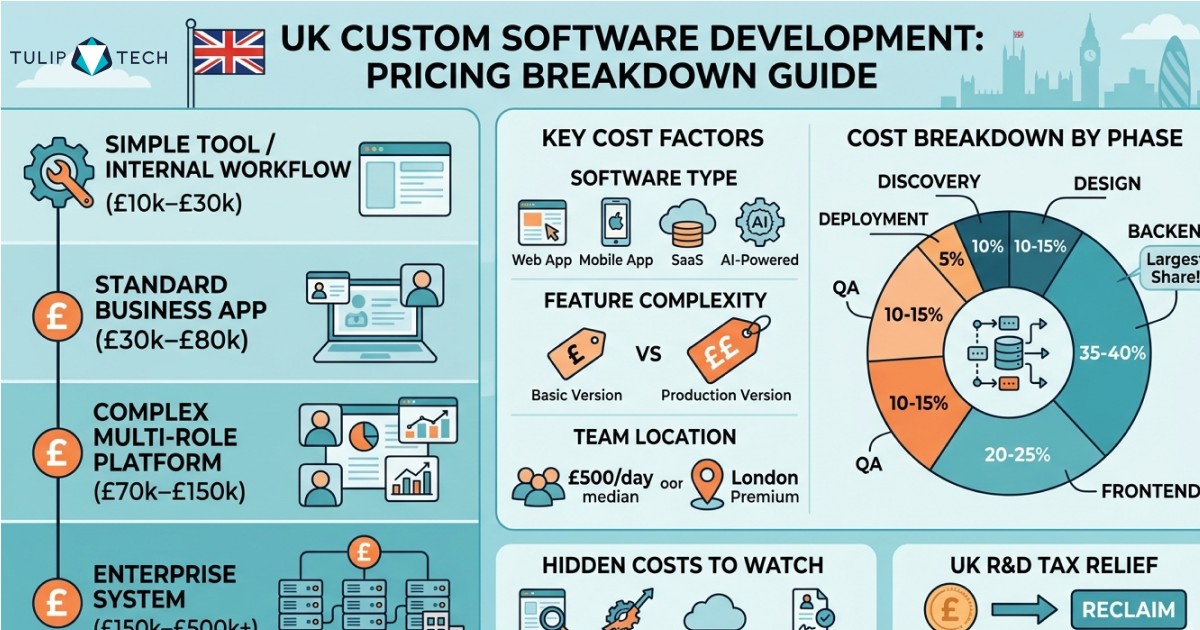
A simple tool or single-purpose system costs £10,000 to £30,000, a standard business application £30,000 to £80,000, a complex multi-role platform £70,000 to £150,000, and an enterprise or multi-system build £150,000 to £500,000 and beyond.
These are commercial UK ranges, not offshore-only figures. Where you land inside them depends on the software type, the feature ambition, the compliance load, and the team, each of which the sections below break down.
What software development costs by type
The kind of software you are building changes the cost as much as its complexity, because each type carries different core work.
Internal tool or workflow system: £15,000 to £50,000, where the value is automating a process rather than polish.
Web application: £30,000 to £90,000, with accounts, a backend, and integrations.
Mobile app: £30,000 to £150,000, with the platform decision driving the figure; our App Development Cost guide breaks this down in full.
SaaS platform: £50,000 to £150,000+, with multi-tenancy, billing, and scaling built in.
Enterprise system: £150,000 to £500,000+, spanning multiple modules, integrations, and user roles.
AI-powered software: £60,000 to £200,000, where model integration and data pipelines sit on top of a standard build.
What individual features cost
Inside any build, features are the unit that moves the number, which is why a vague brief produces a wide quote. These indicative UK ranges show the spread.
User accounts and access control: £2,000 to £6,000, rising with single sign-on and granular roles.
Payment or billing integration: £5,000 to £12,000 per gateway, plus ongoing fees.
Admin dashboard and reporting: £8,000 to £20,000, often underestimated because it is a second product.
Third-party API integration: £3,000 to £12,000 per system, depending on the data flows.
AI or machine-learning module: £15,000 to £50,000, plus model running costs.
GDPR and compliance layer: £5,000 to £15,000 for a data-handling system.
Each feature has a basic and a production version, with a three-to-five-times gap between them, so the level of ambition in the brief decides the band more than any single rate.
Where the cost lands by phase
A software project does not split cost evenly, and knowing the breakdown lets you read a quote. A useful split is discovery 10 percent, design 10 to 15 percent, backend 35 to 40 percent, frontend 20 to 25 percent, QA 10 to 15 percent, and deployment 5 percent.
The backend share surprises buyers who picture cost as screens, but for any system with real data and rules the server side is the largest line. Reading a quote phase by phase shows whether discovery and QA, the phases rushed projects cut, have been properly resourced. A quote with no discovery line, or one under £3,000, is quoting against an unvalidated brief.
UK developer rates, by role and by region
Where the team sits is the largest single lever on cost, and the UK rates below are sourced rather than invented, because several competitor guides quote offshore rates as if they were UK ones.
The ITJobsWatch median for a UK software developer is around £500 per day, roughly £65 per hour, with senior engineers at £625 per day or £80 per hour. By role, expect junior £300 to £450 per day, mid £450 to £600, senior £500 to £700, and an architect or AI specialist £700 to £1,000.
Region matters too. A regional UK agency charges £350 to £550 per day, while a London senior team reaches £600 to £900, a 20 to 40 percent London premium.
Nearshore Eastern European teams run £28 to £60 per hour and South Asian teams £20 to £40. Any quote citing "£20 to £40 per hour" as a UK rate is mislabelling offshore pricing, which is a useful tell about the rest of the quote.
Agency, freelancer, or offshore: the real trade-off
The day-rate gap between routes is real, but the project-cost gap is smaller, because cheaper teams usually need more management, more discovery, and more rework. A UK agency suits unclear-scope projects needing close collaboration; a freelancer suits a small, well-defined piece; and offshore suits a fully specified build with strong in-house management.
We have seen offshore projects land 20 to 35 percent cheaper on a tight specification and more expensive when the spec was loose, because the saving evaporates in rework. The deciding factor is brief clarity and oversight, not the headline rate, and the cheapest quote is rarely the cheapest project.
Fixed price versus time and materials: who carries the risk
The pricing model matters as much as the number, because it decides who absorbs the uncertainty. The two main models distribute risk in opposite directions.
A fixed-price contract gives cost certainty but prices in a risk premium of 10 to 25 percent, because the agency carries the overrun risk, and every change becomes a separately priced request.
Time and materials transfers the risk to you and is cheaper when scope is well defined, but the final cost is less predictable. The model experienced buyers use is a hybrid: a fixed-price discovery to define the scope, then a time-and-materials build against it, which de-risks both sides. Whichever model you choose, the contract should assign full IP ownership of code, designs, and documentation to you at handover, and a mutual NDA should be signed before any confidential detail is shared.
The hidden costs that wreck a software budget
The build figure in a quote is not the total, and the costs that blow budgets are usually the ones left out. Plan for them from the start.
Scope creep adds 10 to 30 percent when the brief is loose, prevented only by a signed specification at the end of discovery. Technical debt from a rushed build adds 20 to 30 percent in later rework. Cloud hosting scales with usage, from £100 to £500 a month for a simple system up to £2,000 to £8,000 for a high-volume one.
Compliance certification, internal staff time managing the project, and third-party licences are all real lines that optimistic quotes omit.
What UK public-sector failures teach about software cost
The most expensive UK software lessons are public record, and no competitor cost guide cites them. The National Audit Office reported that the FiReControl project wasted at least £469 million and delivered no working system, leaving eight of nine control centres empty.
HMRC's Making Tax Digital programme exceeded its £1 billion budget by around £300 million, partly through inadequate testing of custom software. The cause in these cases was not bad engineering; it was scope that moved after the budget was set and optimism baked into the original estimate, a pattern the NAO has documented across government projects.
The lesson for any buyer is direct: lock the scope before the budget, fund a real discovery, and treat a suspiciously low estimate as a warning, not a bargain. The cheapest way to control software cost is the discipline to estimate it honestly.
The five-year total cost of ownership
Judge a software build over five years, not at launch, because the build is roughly half the lifetime cost. Annual maintenance runs 15 to 25 percent of build cost, covering fixes, security patches, and platform updates, and a system left unmaintained accumulates security risk and breaks as its dependencies age.
A £60,000 build typically becomes £130,000 to £170,000 over five years once maintenance, hosting, and a likely mid-life upgrade are counted. Plan for that figure, because the organisations that budget only for the build meet the rest of the cost as a series of unwelcome surprises.
The rebuild tax and how to avoid it
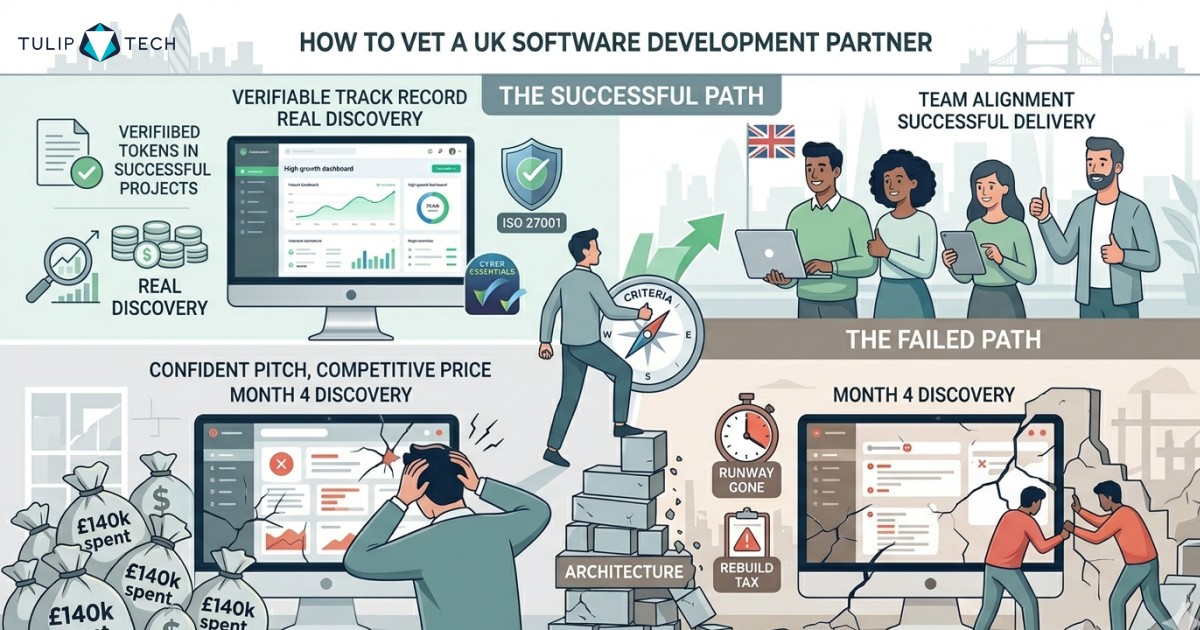
The cheapest quote is often the most expensive project, because software built down to a price frequently needs replacing within two years. We are regularly the second supplier a client hires, brought in to rebuild what the first one left behind.
The arithmetic is unforgiving: a £20,000 system that cannot scale, then a £60,000 rebuild, costs far more than a £45,000 system built properly once. The way to avoid the rebuild tax is to invest in discovery, choose a partner on delivered outcomes rather than day rate, and build for the load you expect in eighteen months, not just today.
The UK R&D tax relief most businesses never claim
Building genuinely new software often qualifies for R&D tax relief, and most UK businesses underclaim it. Under the merged R&D Expenditure Credit scheme, qualifying development earns a 20 percent above-the-line credit, worth around 15 percent net to a profit-making company, per the gov.uk guidance on Corporation Tax R&D relief, with loss-making R&D-intensive companies able to claim more.
The caveat matters: routine development on mainstream frameworks does not qualify, and HMRC increasingly rejects such claims. Relief applies to work that resolves genuine technological uncertainty, so document that uncertainty as you go and you have a defensible claim that materially lowers the net cost of the build.
How to reduce software development cost without cutting corners
Three levers genuinely lower cost without compromising what you get. Phased delivery is the largest: build a focused first version, put it in front of users, and fund the next phase from what you learn rather than paying upfront for features nobody opens.
Ruthless scope discipline is the second, because the system that ships with the essential features and adds the rest later consistently costs less and learns faster. A sensible team mix is the third, where a UK lead with offshore delivery cuts cost without the rework a pure-offshore arrangement risks on a loose brief. What never works is chasing the cheapest rate, skipping discovery, or taking the lowest quote without weighing delivery risk.
If you want a costed, honest scope for your project, our software development team builds custom systems for UK businesses across regulated and high-growth industries, and our guide to choosing a software development company covers how to compare partners.
Frequently Asked Questions
How much does custom software development cost in the UK?
Custom software development costs £10,000 to £30,000 for a simple tool, £30,000 to £80,000 for a standard business application, £70,000 to £150,000 for a complex platform, and £150,000 to £500,000+ for an enterprise system. The figure depends on the software type, feature ambition, compliance load, and team location.
What are UK software developer day rates?
The ITJobsWatch median is around £500 per day for a UK developer and £625 for a senior engineer, roughly £65 to £80 per hour. Regional agencies charge £350 to £550 per day and London teams £600 to £900. Rates quoted at £20 to £40 per hour are offshore, not UK.
Why do software development quotes vary so much?
Each supplier fills the gaps in your brief with its own assumptions about scope, complexity, team, and quality. The cheapest quote usually assumes the least, and a low estimate often signals scope that will be renegotiated later. A tighter brief and a real discovery phase produce quotes you can actually compare.
Does software development qualify for UK R&D tax relief?
Only the part that resolves genuine technological uncertainty. Routine development on mainstream frameworks does not qualify, and HMRC increasingly rejects such claims. Where it applies, the merged R&D scheme gives a 20 percent above-the-line credit, worth around 15 percent net of qualifying spend.
What is the five-year cost of custom software?
Around double the build cost. Annual maintenance runs 15 to 25 percent of the build, and a £60,000 build typically reaches £130,000 to £170,000 over five years once maintenance, hosting, and a mid-life upgrade are counted. Budgeting only for the build is the most common costing mistake.