
WTV is a global platform provider for virtual events. The company helps large MNCs and government agencies reach their audiences around the world. It operates its own proprietary technology platforms and data centres to serve clients like Nestlé,BP, HSBC, WTO, and the European Space Agency. They had been running their servers on Dell machines using VMware. This setup had been both costly and cumbersome. Functionality was missing and managing the systems was hard. TulipTech helped change their infrastructure to massively improve their operations. We moved their servers over to high-end Huawei machines and implemented virtualisation through Proxmox. We also implemented Ceph storage clustering and optimized their network setup. Live backups and redundancy resulted in HA and increased uptime. Our efforts made their server setup easy to manage and monitor, more reliable, and more cost-effective...



May 14, 2026
WTV is a global platform provider for virtual events. The company helps large MNCs and government agencies reach their audiences around the world. It operates its own proprietary technology platforms and data centres to serve clients like Nestlé,BP, HSBC, WTO, and the European Space Agency. They had been running their servers on Dell machines using VMware. This setup had been both costly and cumbersome. Functionality was missing and managing the systems was hard. TulipTech helped change their infrastructure to massively improve their operations. We moved their servers over to high-end Huawei machines and implemented virtualisation through Proxmox. We also implemented Ceph storage clustering and optimized their network setup. Live backups and redundancy resulted in HA and increased uptime. Our efforts made their server setup easy to manage and monitor, more reliable, and more cost-effective.
WTV is a virtual event and communication pioneer founded in the UK in 1991. With three decades of rich history in the industry, they help major organizations and corporations engage audiences on a global level. At present, WTV manages projects in over 50 countries in 25 languages for 200+ clients, with offices in Geneva, Zurich, Frankfurt, London, Madrid and Hong Kong and a global network of partners.
WTV had been hosting its servers on a collection of Dell systems. Most of these were virtualised on VMware ESXi software. The rest of them were running on bare metal. The virtual machines were being used to host servers for critical workflows. This included development, staging and production applications and systems.
Virtualisation using VMware ESXi was both limiting and cumbersome. The existing solution did not provide high availability HA, resulting in downtime losses. Other advanced features like clustering were also unavailable.
Management and monitoring of infrastructure was another problematic area with VMware. Each Dell machine had to be managed individually, and centralised monitoring needed an expensive vCenter license. The Dell machines also had low capacity and did not support high bandwidth applications. This created slowdowns in network traffic.
These shortcomings led to difficulties in patching and maintenance. Time was also being wasted on infrastructure management, and downtime risks were also high for production. The lack of automatic backup and restore features was putting data at risk. Overall, the whole situation was in dire need of major improvements. To address these challenges, WTV decided to utilise TulipTech’s expertise. We realised that to add value to the situation, we had to answer the following questions.
Our biggest improvement was to shift the whole virtualisation framework over to Proxmox Virtualisation Environment from VMware. Proxmox VE 7.x is an opensource server manager with more accessible features. It offers HA, VM clustering, and centralized management for free as standard.
We also decided to change WTV’s physical servers. The new backend was implemented on three high-end Huawei machines. These machines ensured enough processing power and futureproofing.

To optimize for high throughput, we ran the clustered storage on Ceph. Ceph allowed us to make the storage clusters reliable through redundancy. Ceph was configured towards HA through Proxmox. This meant hardware failovers could be handled by live switching gateways between nodes. Backups were also stored on both local and remote storage through NFS.
One of the key challenges TulipTech faced was latency issues between storage clusters. High latency between Ceph storage systems on Proxmox clusters resulted from network configuration inefficiencies. The storage had been configured via internal fibre alone. We resolved these issues by installing Huawei gigabit switches and setting up VLAN between them. This fixed the storage latency issues entirely.
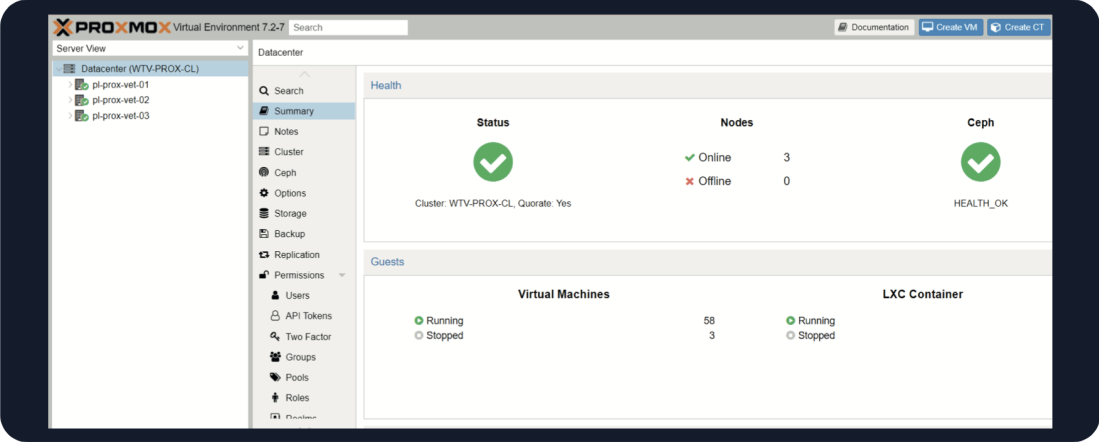
Lastly, we also advised WTV to get a Proxmox VE enterprise subscription. This affordable subscription enabled WTV to receive the latest production grade patches from Proxmox’s enterprise repositories.
Our changes to the backend made WTV’s server infrastructure fast, reliable, and scalable. Operating on Proxmox, the three new servers handled 45+ VMs for critical production workloads. These operated with HA and redundancy. WTV’s infrastructure gained significant resilience against hardware failovers, and downtime was significantly reduced. We set up live backups for the VMs to onsite and offsite storage, further reducing risks. Unified server monitoring and management became possible through Proxmox. This made it fast and easy to maintain the whole backend setup. As a bonus, the core Proxmox VE is free to use, massively reducing long-term overhead costs for WTV Overall, TulipTech made WTV’s servers more affordable, reliable, and easy to operate. The new infrastructure is also very scalable, and can be expanded easily in the future if needed.
The main objective of this project was to improve WTV’s server backend. The aim was to make their servers more efficient and reliable.
Changing their virtualisation platform over to Proxmox made it easy to manage and monitor their servers. We implemented Seph storage clustering and high throughput network cards to increase efficiency. It was a challenge to overcome latency between storage clusters, but my team overcame it by improving their networking setup. We even increased their resilience against hardware failures through setting up live backups and HA.
We are proud to know that our efforts will help WTV to serve their clients with more ease and confidence. Their backend is now both cost efficient and robust, and flexible to meet future needs.
Masum Shamjad
Founder and CEO, TulipTech
If you would like to know more about how TulipTech can help with System Integration of your platform with different technologies, such as WebRTC, OTT , VoD , Webcast , RestAPI , SDKs, Mobile& TV apps please reach out to the TulipTech Team.
Contact Us
Get in touch with our team anytime today.
Our team is always here to listen, support, and guide you.
Development
Similar Case Studies

Subscribe for the good stuff (no spam, ever).

Providing top-notch technology solutions that you can trust to transform your growing business
Services
Get In Touch

Ahmedabad
714, Shivalik Shilp, Iscon Cross Road, SG Highway, Satellite, Ahmedabad – 380015, Gujarat, India.
+91 63532 74556© 2011-2026 TulipTech is the trading name of TulipTech Ltd., registered in England, company number 07486882, registered office: Unit 7 Friars Mill, 100 Bath Lane, LEICESTER, England LE3 5BJ. We are also registered with the Information Commissioner's Office, reference: ZB641657.