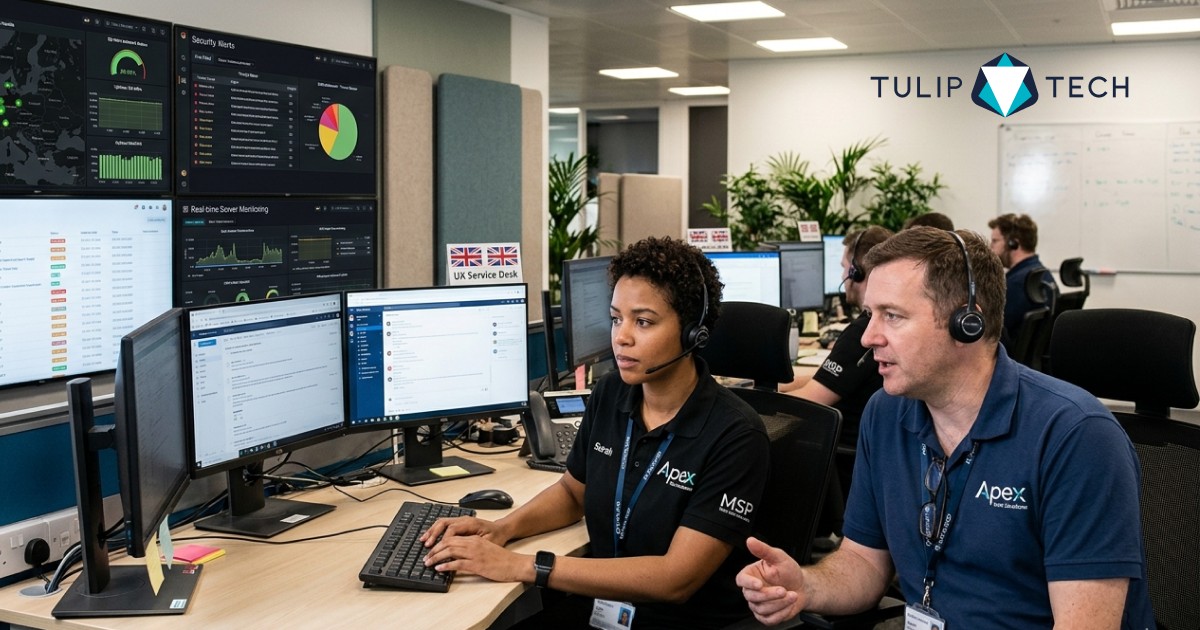
It is a Tuesday morning, your systems are down, and the one person who understands your network is on holiday. For a growing number of UK businesses, that scenario is exactly why they moved to managed IT services: predictable support, defined response times, and a team rather than a single point of failure.
IT managed services has quietly become one of the largest parts of the UK technology economy, and in 2026 it is the default model for businesses that have outgrown ad-hoc support but do not want to build a full in-house IT department.
This guide maps the market with authoritative data, sets out the core service types, shows what UK businesses actually pay per user, explains the SLAs that decide whether a contract is worth signing, and gives you the in-house-versus-MSP maths and the framework to choose the right provider.
The UK managed IT services market in 2026
The scale surprises people. According to GOV.UK research from the Department for Science, Innovation and Technology, the UK has 11,492 active managed service providers generating £52.6 billion in revenue, contributing £29.1 billion in gross value added and employing more than 294,000 people.
The market is also barbell-shaped, and that shape matters for who you hire. Large firms make up just 4 percent of MSPs but earn 74 percent of the revenue, while micro-MSPs are 59 percent of providers but earn only 3 percent. Most UK SMEs are choosing between a one-or-two-engineer micro-MSP and a mid-tier provider, and the difference in resilience between them is large.
Growth is steady, with the sector having grown at 12 percent a year to 2022 and projected to reach £77.3 billion by 2027. The takeaway for a buyer is that this is a deep, competitive market, so the question is not whether managed IT exists for your size of business, but which provider fits.
What managed IT services actually cover
Managed IT services means outsourcing the day-to-day running and support of your technology to a provider under a contract, for a predictable monthly fee. The provider monitors, maintains, secures, and supports your systems, replacing either ad-hoc break-fix support or a stretched in-house team.
The work splits into four core areas, and most providers bundle them into tiers.
Helpdesk and end-user support
The visible layer is the helpdesk your staff contact when something breaks, by phone, email, or portal. A good MSP resolves most issues remotely and fast, and the quality of this layer is what your team feels every day.
Infrastructure monitoring and maintenance
Behind the scenes, the MSP monitors servers, networks, and devices around the clock, patching and updating them to prevent problems rather than just fixing them. Remote monitoring and management tools flag a failing disk or a missed patch before it becomes an outage.
Cybersecurity and backup
Security is now central rather than an add-on, covering endpoint protection, firewalls, email filtering, and managed backup with disaster recovery. Only around 30 percent of UK MSPs offer managed security per the GOV.UK research, so a provider that does is already in a minority.
Strategy and IT roadmap
The best MSPs also act as a virtual IT director, planning upgrades, budgets, and the technology roadmap. This strategic layer is what separates a true managed-services partner from a glorified helpdesk.
The types of managed IT services you can buy
Beyond those four layers, managed IT is sold as distinct service lines, and most providers let you take all of them or only the ones you lack. Knowing the types helps you buy what the business needs and skip what it does not.
Managed network and infrastructure
This covers your servers, switches, firewalls, and connectivity, monitored and maintained so the plumbing of the business stays up. For most firms it is the foundation every other service sits on.
Managed cloud services
Managed cloud is the running of your Azure, Microsoft 365, or AWS environment, which is different from simply buying the cloud. The provider handles configuration, cost control, and security, because a cloud platform left unmanaged drifts into overspend and open doors.
Managed security and detection
Managed detection and response puts a security team and tooling around your systems around the clock, going beyond antivirus to active threat hunting. Because many providers resell basic antivirus rather than run a true detection service, it is a line worth confirming a provider genuinely operates.
Managed backup and disaster recovery
This is the guarantee that your data is copied, tested, and recoverable, with a defined time to get you running again after an incident. Untested backups are the most common nasty surprise in a real recovery.
Managed communications and VoIP
Phones, video, and messaging run as a managed service too, keeping the tools your team talks through reliable and supported. It often sits with the same provider that runs your network.
Managed print and device management
Printers, endpoints, and mobile devices are managed, patched, and secured as a fleet rather than one at a time. It is unglamorous, but unmanaged devices are a common way in for attackers.
Managed SaaS and licence management
Someone has to track the Microsoft 365, Adobe, and other licences a business accumulates, right-sizing them and removing leavers. Left alone, it is a quiet source of both overspend and security risk.
Most UK businesses buy several of these as a bundle, which is why pricing is usually quoted per user rather than per service.
What UK businesses gain from managed IT
The reason businesses move to managed IT is rarely the technology itself; it is what predictable, supported IT frees them to do. The first gain is cost predictability, where a fixed monthly fee replaces the lumpy, unplanned bills of break-fix.
The second gain is a whole team instead of a single point of failure, with cover when someone is ill or on leave. The third is the security and compliance depth a small in-house team cannot build alone, and the fourth is the strategic capacity to plan ahead rather than firefight.
Fewer outages, predictable costs, and time back for the work that grows the business.
Those gains only pay off if the price is right, which is where most buyers look next.
What UK businesses actually pay for managed IT
Pricing is where buyers most want clarity, and UK managed IT is sold on a few clear models. The dominant one is per-user pricing, which bundles all of a person's devices and support into one monthly figure.
UK per-user pricing typically runs £40 to £55 a month for a basic tier, £65 to £95 for a standard tier, and £100 to £150 for a premium tier with security and strategy included. Per-device pricing, at roughly £30 to £80 per device a month, suits asset-heavy environments where users have many machines rather than one. Tiered or all-inclusive contracts wrap everything into a fixed fee, and break-fix, paying per incident, still exists but produces lumpy, unpredictable bills.
Two less common models are worth knowing. A la carte pricing charges for individual services rather than a bundle, while value-based pricing ties the fee to agreed outcomes rather than headcount, though per-user remains the UK default because it is the easiest to budget.
What a UK business pays for managed IT per year
The per-user figure becomes real at scale. A 25-user business on a standard £80 tier pays around £24,000 a year, a 50-user business around £48,000, and a 100-user business on a £100 premium tier around £120,000.
Those totals are the honest basis for comparison with an in-house team, which the next section sets out. Watch for suspiciously low per-user prices, because a £10-to-£15 per-user quote usually means monitoring software with little human support behind it.
In-house team versus an MSP: the five-year maths
Every MSP claims to be cheaper than hiring in-house, and almost none shows the workings. Here they are. A single mid-level UK IT manager costs around £45,000 to £55,000 in salary, and with employer National Insurance, pension, holiday cover, training, and tools the true cost is closer to £65,000 to £75,000 a year, for one person with no cover when they are ill or on leave.
A mid-tier MSP supporting a 50-user business at a standard tier costs around £48,000 a year and provides a whole team, 24/7 monitoring, security, and holiday-proof cover. Over five years the in-house single hire costs £325,000 to £375,000 for one person's hours, while the MSP costs around £240,000 for a team, a 25 to 45 percent saving with more capability.
The maths flips only at scale, where a business of several hundred staff can justify a full in-house department, and even then a co-managed model is often the answer.
Co-managed IT: the model most mid-sized UK firms actually need
The choice is not only in-house or outsourced. Co-managed IT, where an MSP works alongside your existing IT staff rather than replacing them, is the model that fits most UK firms of 25 to 500 employees, and competitors rarely cover it.
In a co-managed arrangement your in-house person or small team handles the day-to-day and the business context, while the MSP provides the round-the-clock monitoring, the security depth, the specialist skills, and the holiday cover one person cannot. It removes the single-point-of-failure risk of a lone IT manager without the cost of a full department.
For a growing business, co-managed IT is often the step between a single hire and a full team, and it scales smoothly as you grow. If your IT has outgrown one person but not yet justified five, this is usually the right model.
What switching to a managed IT provider looks like
The switch itself worries buyers more than the contract, and a good provider makes it methodical. It starts with discovery, an audit of your systems, licences, and risks that often surfaces problems no one had documented.
Migration follows, moving monitoring, security, and support onto the provider's tools in stages so nothing breaks at once. The first 90 days are where the relationship is proven, as the backlog of long-ignored issues gets cleared.
Transitions go wrong when the audit is rushed or the outgoing provider is uncooperative, so agree the handover and data export before you sign, not after. A provider that cannot describe its onboarding in plain terms is one that does not have a real process.
The SLAs that decide whether a contract is worth signing
The service level agreement is where a managed IT contract is really made or broken, and a vague SLA is a warning sign. A serious SLA defines response and resolution times by severity, not a single blanket number.
A typical tiered SLA looks like this. A priority-one critical issue, such as a full outage, should carry a 15-to-30-minute response and an aggressive resolution target.
A priority-two major issue, affecting a team but not the whole business, should see a one-to-four-hour response. A priority-three minor issue, such as a single user's printer, carries a longer target.
Alongside response times, check the uptime guarantee, usually 99.5 percent or better, what the penalties are if the MSP misses targets, and whether on-site support is included or charged at £75 to £120 an hour. An SLA without severity tiers, penalties, and clear scope is one the provider can interpret in its own favour.
The KPIs that show a managed IT provider is performing
An SLA sets the promises; the KPIs tell you whether the provider keeps them. Track first-contact resolution, the share of tickets fixed without escalation, and mean time to resolution across severity levels.
Watch patch compliance, the percentage of devices fully up to date, because it is the clearest sign that proactive maintenance is real rather than promised. Add a satisfaction score on closed tickets, since a fast fix that frustrates your staff is not a good fix.
Uptime alone flatters a provider, so favour the ones that show these numbers monthly without being asked. These measures only matter once you have chosen managed services over the older break-fix model.
Managed IT versus break-fix
For businesses still weighing whether to move to managed services at all, the comparison with break-fix is the heart of the decision. Break-fix means calling someone when something breaks and paying per incident, at £75 to £150 an hour.
Break-fix looks cheaper because you only pay when something goes wrong, but it aligns the provider's incentive with your problems, not your uptime, and it produces unpredictable bills and reactive firefighting. Managed services costs a predictable monthly fee and aligns the provider with keeping you running, because under a fixed fee their profit depends on fewer incidents, not more.
The crossover comes early. Once a business passes roughly 20 employees, the cost and disruption of break-fix outages usually exceed the managed-services fee, which is why most UK firms above that size have moved to a managed model.
How AI and automation are changing managed IT in 2026
The managed IT model is being reshaped by automation, and the better providers already run on it. Routine patching, monitoring alerts, and ticket triage are increasingly handled by automated tools, freeing engineers for the work that needs judgement.
Predictive maintenance is the bigger shift, where models flag a failing disk or a saturated link before it causes an outage, turning reactive support into prevention. For buyers this should mean fewer incidents and tighter SLAs rather than a higher bill, so ask a provider what it has actually automated.
Automation does not remove the need for people; it changes what they do, from rekeying alerts to solving the problems that matter. Whatever a provider automates, how far you can trust it still rests on its own security posture.
Security and compliance: use accreditation as a filter
Because an MSP holds the keys to your systems, its own security posture is your security posture. UK accreditations are the fastest way to filter the field, and the GOV.UK data shows they are a genuine differentiator rather than table stakes.
Cyber Essentials is the UK baseline, Cyber Essentials Plus adds independent testing, and ISO 27001 signals mature information-security management. With only around 30 percent of UK MSPs offering managed security and 23 percent offering compliance and risk services, a provider holding these is already in a minority. For regulated buyers in finance, health, or critical infrastructure, an MSP's own regulatory posture, including its scope under the NIS regulations, should be a procurement requirement, not a nice-to-have.
Verify any claim against the certifying body rather than trusting a badge on a website, because lapsed certifications are common.
Managed IT for regulated UK industries
Some sectors cannot treat IT support as generic, because their regulator has a view on it. A healthcare provider must meet the NHS Data Security and Protection Toolkit, a financial firm answers to the FCA, and both need a provider that understands those obligations.
For these buyers the MSP's own compliance scope, including where it sits under the NIS regulations, is part of your compliance rather than a separate matter. Ask for evidence the provider has worked in your sector and can produce the records an audit will demand.
What that looks like in practice is easiest to see in a real situation.
An anonymised case: what good managed IT actually changes
Numbers land harder against a real situation. A 70-person professional-services firm we know moved from a single overstretched IT manager to a co-managed arrangement after a server failure cost them two days of work.
Within six months, helpdesk tickets were resolved a third faster, unplanned downtime had effectively stopped because monitoring caught issues early, and the in-house manager was freed from firefighting to work on the projects the business actually needed. The monthly fee was higher than the manager's tools-and-time had appeared to cost, but the downtime it prevented, valued at thousands of pounds a day, paid for it many times over.
The lesson is the one the maths above implies: the cost of managed IT is visible and predictable, while the cost of not having it shows up as outages, slow recovery, and a key person who cannot be replaced.
The red flags that should make you walk away from an MSP
A few signs tell you a provider is wrong before the contract does. A vague SLA with no severity tiers or penalties, a quote far below the going rate, and no named account owner are the common three.
Add a refusal to put exit and data-export terms in writing, security accreditations that cannot be verified with the certifying body, and support that turns out to be offshore when you needed someone on site. Any one of these is a reason to keep looking.
The providers worth shortlisting answer all of this plainly, because they have nothing to hide.
How to choose the right MSP
With a deep market and a barbell of provider sizes, choosing well comes down to a few concrete filters. Match the provider's size to yours, because a micro-MSP may struggle to give a 200-person firm 24/7 cover, while an enterprise integrator may not prioritise a 20-person client.
Check accreditation against the certifying body, read the SLA for severity tiers and penalties, and confirm whether security and strategy are included or cost extra. Ask for two reference clients in your size band and sector, confirm who actually answers the phone and whether support is UK-based, and read the exit terms so you are not locked in if the relationship sours. A provider that answers these plainly, with a clear SLA and transparent pricing, is the one to shortlist.
If you are weighing managed or co-managed IT for a UK business, our IT infrastructure team provides monitoring, support, security, and strategy under clear SLAs, and our cyber security service covers the accreditation-grade protection a modern MSP should bring.
Frequently Asked Questions
How much do managed IT services cost in the UK?
UK managed IT typically costs £40 to £55 per user a month for a basic tier, £65 to £95 for standard, and £100 to £150 for premium with security and strategy. Per-device pricing runs £30 to £80 a month. A 50-user business on a standard tier pays around £48,000 a year, usually 25 to 45 percent less than an equivalent in-house hire with cover.
What do managed IT services include?
They cover helpdesk and end-user support, around-the-clock infrastructure monitoring and maintenance, cybersecurity and managed backup, and strategic IT roadmap planning, for a predictable monthly fee. The best providers act as a virtual IT director rather than just a reactive helpdesk.
What is co-managed IT?
Co-managed IT is where an MSP works alongside your existing in-house IT staff rather than replacing them, providing 24/7 monitoring, security depth, specialist skills, and holiday cover. It suits UK firms of roughly 25 to 500 employees that have outgrown a single IT hire but do not yet justify a full department.
Is managed IT cheaper than hiring in-house?
For most SMEs, yes. A single mid-level UK IT manager truly costs £65,000 to £75,000 a year for one person with no cover, while a mid-tier MSP supporting a 50-user business costs around £48,000 for a whole team with 24/7 monitoring. Over five years that is a 25 to 45 percent saving with more capability.
What should a managed IT SLA include?
A serious SLA defines response and resolution times by severity, with a 15-to-30-minute response for critical outages and one to four hours for major issues, plus an uptime guarantee of 99.5 percent or better, penalties for missed targets, and clear scope on what is included versus charged extra. An SLA without severity tiers and penalties is a warning sign.
What types of managed IT services can I buy?
The common service lines are managed network and infrastructure, managed cloud, managed security and detection, managed backup and disaster recovery, managed communications and VoIP, managed print and device management, and SaaS licence management. Most UK providers bundle several into a per-user fee, and you can usually take only the lines your business lacks.
Can I leave my managed IT provider if it is not working?
Yes, but only cleanly if the contract says so, which is why the exit terms matter before you sign. Check the notice period, who owns the data and documentation, and how monitoring and security pass to the next provider. A provider that resists clear exit and data-export terms is a warning sign.
Does a managed IT provider offer after-hours and emergency support?
A proper managed contract includes around-the-clock monitoring and a defined response to critical issues at any hour, not only in office hours. Confirm what counts as an emergency, the response time for it, and whether on-site call-out is included or charged separately, because the answer varies widely between providers.