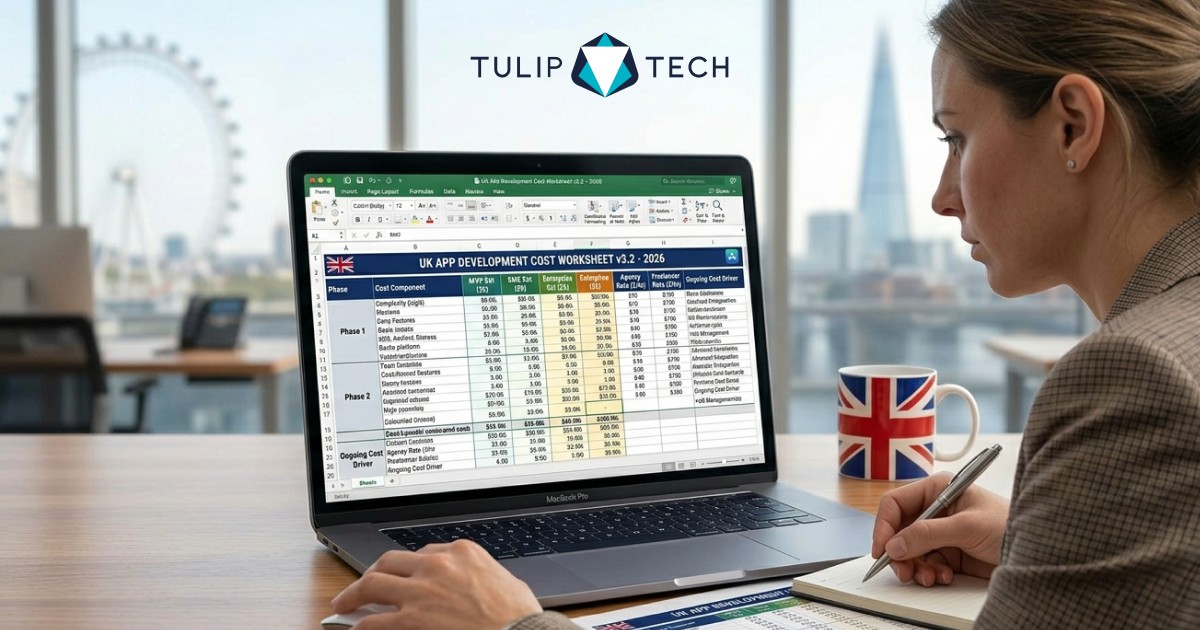
You have an idea, a product, or a board paper that says "we need an app." The next sentence is always the same. "What is this going to cost?"
The honest answer is that app development cost in the UK does not exist as a single number. It is a structure built up across five phases, multiple platform options, and a list of choices that move the total by tens of thousands of pounds in either direction.
What follows maps every phase, the cost by app type and by feature, the levers that move the number, and what to prepare before any developer starts quoting. For Android, iOS, web, or education builds, the dedicated cost guides for each platform go deeper than this overview can.
What app development cost in the UK actually includes
The UK sits inside a fast-growing market. Grand View Research values the UK mobile application market at around 14.2 billion US dollars in 2024, rising to 32.9 billion by 2030 at a 15.4 percent annual growth rate. With roughly 53 million UK smartphone owners, demand for well-built apps is not the constraint; budgeting for them accurately is.
App development cost in the UK is the total spend across discovery, design, build, launch, and the first 12 to 24 months of running the product. Most quotes cover only the build. The other four phases sit outside the headline number and decide whether your project ships on time and survives 18 months in market.
The four complexity bands
The headline ranges most UK businesses meet sit at four levels of complexity. Use them as anchors, then read the per-type and per-feature sections below to narrow the figure.
Simple single-platform app or MVP: £10,000 to £30,000, with three to five core features in 8 to 12 weeks.
Standard business or web app: £30,000 to £80,000, with multiple roles and light integrations in 12 to 20 weeks.
Complex multi-role product: £70,000 to £150,000, with real-time data or third-party integrations in 20 to 32 weeks.
Enterprise or multi-system build: £150,000 to £500,000 and up, spanning platforms and deep integrations over six months or longer.
The five phases and where the cost lands
A useful split across the typical build is discovery 7 to 12 percent, design 12 to 18 percent, build 45 to 55 percent, testing 10 to 15 percent, and launch 2 to 5 percent. The phases run as follows.
Discovery and scoping: £5,000 to £12,000 over two to four weeks. Design and prototyping: £5,000 to £25,000 over three to six weeks. Build: £8,000 to £200,000+ over 8 to 26 weeks.
Testing, launch, and store submission: £3,000 to £15,000 over two to four weeks. Annual maintenance: 15 to 25 percent of build cost per year, continuous.
The five phases that follow start with the work that happens before any code is written.
Phase 1: Discovery and scoping
Discovery is the phase that prevents most cost overruns and is also the one most often skipped. It runs two to four weeks at £5,000 to £12,000 for a commercial discovery on a standard project.
A business analyst, a product designer, and on complex builds a technical architect map the functional requirements, user flows, integration touchpoints, and data architecture. The output is a written specification every developer can quote against.
Skipping discovery is the most expensive shortcut in app development. The saving is small, while the cost of building the wrong thing, or pricing the right thing wrong, usually adds 30 to 50 percent to the original budget.
Discovery is also where the MVP question gets answered. An MVP ships the smallest version that delivers core value, then iterates, and for most first apps it cuts day-one spend by 40 to 60 percent against a full feature build. The trade-off is a longer total programme, not a worse product.
Phase 2: Design and prototyping
Design follows discovery and runs three to six weeks at £5,000 to £25,000. The output is a clickable prototype every stakeholder can interact with before a developer touches the project.
A templated approach uses an established design system, Material Design for Android or Human Interface Guidelines for iOS, with brand-skinned components. The cost is lower, the build risk is lower, and the result still looks polished.
A custom approach commissions an original design language with bespoke components and animations. The result is more distinctive and costs two to three times more on the design line alone.
Accessibility sits inside this phase and is not optional. WCAG 2.2 AA conformance adds three to five days of design work and a similar amount of testing later, and adding it after launch costs three to four times more than building it in.
Phase 3: Build by platform
The build phase holds the largest share of app development cost, running 8 to 26 weeks for most projects. The total depends almost entirely on the platform decision and the feature set.
Native iOS
Native iOS development uses Swift and SwiftUI for the strongest performance and the deepest hardware integration. UK build costs sit at £15,000 to £40,000 for a simple app, £30,000 to £80,000 for a standard one, and £80,000 to £200,000+ for complex products.
The Apple Developer Program costs $99 USD per year, roughly £79 to £82, and is required to publish. If iOS is your platform, the iOS App Development Cost guide goes deeper on timeline and the regulated-industry premium.
Native Android
Native Android uses Kotlin and Jetpack Compose. The platform's hardware and OEM diversity makes the build harder to test, adding 15 to 25 percent to QA cost compared with iOS.
UK build costs sit at £8,000 to £30,000 for simple, £20,000 to £70,000 for standard, and £70,000 to £180,000+ for complex builds, with a one-time $25 USD Google Play registration. The Android App Development Cost guide breaks down device fragmentation and offshore agency rates.
Cross-platform mobile
Cross-platform development with React Native or Flutter ships one codebase to both iOS and Android, saving 25 to 40 percent against two native apps at the same feature set. Build cost sits at £20,000 to £60,000 for standard and £60,000 to £150,000 for complex products.
For most UK first apps and MVPs this is the right choice. The trade-off is a small performance penalty and slower access to brand-new platform features.
Web apps and progressive web apps
A web app behaves like software in a browser, and a progressive web app adds offline use and a home-screen icon. Both skip app store submission and the revenue cut entirely.
UK build costs run £10,000 to £30,000 for simple, £30,000 to £80,000 for standard, and £80,000 to £150,000+ for complex. PWAs are 30 to 50 percent cheaper than native equivalents, and the Web App Development Cost guide breaks down timeline and team size per tier.
Education and EdTech
Education apps carry their own cost structure because of safeguarding, accessibility, and content production. The Education App Development Cost guide goes deeper on SEND-compliant accessibility and assessment-engine licensing.
Most regulated verticals, including fintech, healthtech, and govtech, carry a similar 10 to 20 percent compliance premium, itemised later in this guide.
What an app costs by type
Founders rarely want the abstract band; they want the number for their kind of product. App type changes the cost as much as complexity does, because each type carries different core features and data demands.
Content or utility app: £15,000 to £45,000, where the value is in a focused single purpose with light backend.
On-demand or booking app: £40,000 to £100,000, with real-time availability, scheduling, and payments.
Two-sided marketplace: £50,000 to £120,000, with two user types, a matching layer, and split payments.
Ecommerce app: £35,000 to £90,000, with catalogue, cart, payments, and order management.
Food delivery app: £45,000 to £110,000, with live tracking, three user roles, and dispatch logic.
AI-powered app: £60,000 to £150,000, where model integration and data pipelines sit on top of a standard build.
What individual features cost
Inside any build, features are the unit that moves the number. These indicative UK ranges show why a brief that lists features as bullet points produces wildly different quotes.
User accounts and authentication: £2,000 to £6,000, rising with social sign-in and two-factor security.
Payments and subscriptions: £3,000 to £8,000 per gateway, plus ongoing transaction fees.
Chat or messaging: £4,000 to £12,000, depending on real-time and media support.
Push notifications: £1,500 to £4,000, including segmentation and scheduling.
Maps and geolocation: £3,000 to £9,000, plus usage-based map API fees.
Admin dashboard: £5,000 to £15,000, often underestimated because it is a second product.
Each feature has a basic version and a production version, and the gap between them is typically a factor of three to five. The level of feature ambition, more than any single rate, decides which complexity band you land in.
How AI features change the cost in 2026
AI is now the most common reason a 2026 app budget moves, so it deserves its own line. Wrapping an existing model through an API, for a chatbot or a recommendation engine, adds £8,000 to £25,000 to a build, plus running costs.
Those running costs are easy to miss. A large language model charged per token can run from tens to several hundred pounds a month at MVP volumes, and scale sharply with usage, so model cost belongs in the five-year total, not just the build.
The expensive version trains or fine-tunes a custom model, which adds data preparation, labelling, and evaluation work that can double the AI line. In our experience, most AI apps should validate with an off-the-shelf model first and only invest in custom training once the value is proven.
Phase 4: Testing, launch, and app store submission
Testing and launch run two to four weeks at £3,000 to £15,000 depending on QA scope. The output is a live app on the App Store, Google Play, or a public web URL.
App store submission carries fixed fees and a revenue share for the life of the product. The Apple Developer Program is $99 USD a year, Google Play registration is $25 USD once, and both stores take 15 to 30 percent of in-app revenue, with the lower tier on the first $1 million per developer per year.
The UK device split matters for the test budget. StatCounter puts UK Android at roughly 50 percent and iOS at roughly 49 percent in 2026, so a UK audience genuinely needs both platforms tested, not one. Apple review now typically takes around 24 hours and Google a few hours, but plan three to four weeks of beta testing through TestFlight or Play Console on top of the QA budget.
Phase 5: Ongoing costs after launch
The launch is not the end of spend. A realistic five-year total cost of ownership for a £40,000 build sits at £75,000 to £95,000 once maintenance, hosting, and platform updates are added.
A UK SaaS client we worked with budgeted a £45,000 cross-platform build with £8,500 a year for maintenance, the textbook 19 percent. By month 18, two iOS releases and one Android compatibility wave had pushed actual maintenance to £11,200, still inside the band but at the top of it. The lesson was to budget the upper end and treat the unspent share as contingency, not saving.
Maintenance and hosting
Annual maintenance runs 15 to 25 percent of build cost a year, covering bug fixes, OS compatibility, security patches, and small features. The wide band reflects the September OS releases from Apple and Google, and any unmaintained app breaks within 12 to 18 months.
A simple production app costs £100 to £500 a month to host, while a high-volume or real-time app sits at £2,000 to £8,000, billed by the cloud provider outside the agency retainer.
GDPR and compliance
GDPR setup costs £3,000 to £7,000 for an app handling UK customer data, with ongoing compliance at £1,500 to £5,000 a year. UK GDPR fines can reach the higher of £8.7 million or 2 percent of global turnover, so this is not a corner to cut.
A worked example: costing a field-service app end to end
Abstract bands land harder against one project. Take a UK field-service app: job scheduling, an engineer mobile app, a customer portal, live tracking, and payments, built cross-platform.
Discovery came in at £9,000 over three weeks, and design at £14,000 for a templated system with a custom booking flow. The build was the bulk at £62,000, split across the engineer app, the portal, scheduling logic, and a payment integration. Testing and launch added £8,000, and project management at 12 percent added roughly £11,000.
The total landed at £104,000, a complex multi-role product, with first-year running costs of about £20,000 for maintenance, hosting, and compliance. Costing it line by line up front is what turned a vague "around sixty grand" assumption into a budget that held.
What drives the number across every app development cost
Six factors decide where in each tier a project lands. Understanding them is the difference between a budget that holds and a quote that drifts.
Feature complexity: the production version of any feature runs three to five times the basic version, so scope ambition is the single biggest swing.
Team location and day rates: UK developers run £500 to £625 per day median per ITJobsWatch, regional agencies £350 to £550, London senior £600 to £900, Eastern European £28 to £60 per hour, and South Asian £20 to £40.
Regulated-industry premium: healthcare, fintech, legal, and education add 10 to 20 percent, itemised below.
Custom versus templated design: custom costs two to three times more on the design line and raises the build cost too.
Third-party integrations: each payment, CRM, ERP, or mapping integration adds API work, error handling, and licence cost.
Project management: 10 to 15 percent of total cost as a named line, and skipping it usually means integration runs over and the launch slips.
The rebuild tax: what the cheapest quote really costs over three years
The cheapest quote is rarely the cheapest project. A £15,000 build from a team chosen on rate alone routinely cannot carry real usage, and validates the idea only to be rebuilt.
Here is the arithmetic we see repeatedly. The £15,000 app reaches its limits around month 12 to 18, the rebuild on a proper architecture costs £45,000 to £55,000, and the three-year total lands near £60,000 to £70,000. A £35,000 build done once, maintained at 20 percent a year, lands near £56,000 over the same three years and never stops working.
The cheap quote feels like a saving and acts like a tax. Budget for the build that lasts, not the quote that wins on day one.
What UK public-sector overruns teach about scoping
The most expensive UK app lessons are public record. The National Audit Office reported that HMRC's Making Tax Digital programme ran roughly 400 percent over its original cost estimate, and the NHS COVID-19 app cost in the region of £36 million.
The cause in both cases was not bad engineering. It was scope that moved after the budget was set, the exact failure a written discovery specification prevents. A founder reading those numbers should take one lesson: lock the scope before the budget, and price every change against it.
Scope discipline is cheaper than any rate negotiation. It is also the discipline a regulated build needs most, because compliance is where unscoped work hides.
The regulated-industry premium, itemised
Competitors say "regulated adds 10 to 20 percent" and stop. Here is what that premium actually buys, so you can budget each line rather than a vague uplift.
Data Protection Impact Assessment: £2,000 to £6,000, mandatory for any meaningful personal-data processing under the ICO.
Penetration testing: £4,000 to £12,000 per round, expected annually for fintech and health products.
WCAG 2.2 accessibility audit: £2,000 to £5,000, and required outright for public-sector work.
NHS Data Security and Protection Toolkit or FCA interplay: legal and assurance time that scales with the regulatory regime.
A fintech or healthtech build should treat these as named lines from the start, not a percentage bolted on at UAT, which is where unbudgeted compliance usually surfaces.
Pricing models for app development
Three pricing models dominate UK agency contracts, each suiting a different level of certainty about what you are building.
Fixed price gives a known total before any code is written. It works when the spec is fully defined and poorly when the brief has gaps, because every gap is filled with the cheapest assumption and renegotiated later.
Time and materials charges for hours delivered against an estimate. You keep control of scope as requirements clarify, at the risk of the final cost exceeding the estimate, and it is the more honest model for research-heavy projects.
Retainer books a fixed number of hours a month, the right structure after the initial build, usually £5,000 to £25,000 a month by team size.
How to read a UK agency quote line by line
Most founders compare quotes on the bottom number, which is exactly how the wrong agency wins. Read the lines instead.
The build line should show day rate times days, not a round number. The project management line should be named at 10 to 15 percent, and its absence means the overhead is hidden in development hours. A contingency line of 10 to 20 percent is a sign of an honest estimator, not a padded one.
Watch what "fixed price" excludes, because that is where change requests live, and confirm whether third-party licences and store fees sit inside or outside the total. A quote you can read line by line is a quote from a partner who expects to be held to it.
UK funding and tax relief for app projects
The build is more affordable than the headline once UK funding routes are counted, and most founders use none of them. Several are worth knowing before you commit.
R&D Tax Relief / RDEC: the merged scheme gives a 20 percent above-the-line credit on qualifying development spend, worth roughly 15 to 20 percent in net cash depending on tax position. On a £60,000 build that is around £9,000 to £12,000 back. The gov.uk guidance on Corporation Tax R&D relief sets out what qualifies.
Innovate UK Smart Grants: competitive grants funding up to 70 percent of eligible costs for genuinely innovative projects.
Start Up Loans: government-backed loans of up to £25,000 per director through the British Business Bank.
Document the development work as you go, not retrospectively, because the R&D claim depends on a contemporaneous record of the technical uncertainty resolved.
What can go wrong, and how to prevent it
Five failure modes account for most app projects that come in over budget or never ship, and each has a known prevention.
Scope creep: prevented by a written, signed-off spec at the end of discovery with change-request pricing for anything beyond it.
Wrong platform choice: prevented by a decision driven by user research and roadmap, not by what sounds good in a board paper.
Wrong agency choice: prevented by a paid two-week pilot before the full contract and reference checks against three live apps.
Skipped discovery: prevented by never accepting a build quote without a discovery output.
No project management line: prevented by insisting every quote names PM at 10 to 15 percent.
How to choose the right app development partner
Three sourcing routes dominate the UK market, each suiting a different mix of budget, brief clarity, and risk appetite.
A UK agency fits when the brief has gaps, the project needs close work with non-technical stakeholders, and the regulatory environment requires UK-based data and accountability. A nearshore Eastern European agency fits a tight specification needing cost reduction without heavy timezone friction, at 30 to 45 percent below UK rates. An offshore South Asian agency is the lowest-cost route, at 50 to 70 percent below UK rates, and works only when the spec is fully defined and someone manages requirements daily.
What to verify before signing
IP ownership of the code, design assets, and documentation is the single most important clause, because many offshore agreements default to the agency retaining rights you do not realise you are signing away. Insist on full assignment of foreground IP at handover, in writing.
An NDA signed before any confidential information leaves your business is standard practice and a useful filter, since any agency that resists a basic NDA is telling you something. Finally, ask to speak to two former clients with apps live in your sector before signing.
What to prepare before you start
Five inputs save 15 to 25 percent on the total when prepared before discovery, and each takes a day or two.
A written summary of what the app does, for whom, and what success looks like in numbers. A feature list split into must-have for launch and nice-to-have for later. A list of every external system to integrate with, including API documentation URLs.
A confirmed budget range and a walk-away maximum, which produces honest proposals rather than padded ones. And a statement of timing constraints, so the agency can staff correctly and flag where compression will cost more.
Bringing it together
App development cost in the UK is a structure, not a number. It runs across discovery, design, build, launch, and the first 12 to 24 months in market, and within that structure the platform, the app type, the feature ambition, and the brief quality decide where you land.
The shortest path to a budget that holds is a clear discovery output, a written spec, a named PM line, and a phased delivery that gets a working MVP to market before the full feature set is built.
If your project sits at the planning stage, our mobile app development team scopes builds across iOS, Android, cross-platform, and web for UK businesses. The right number depends on the brief, and the right brief is built in discovery, not in a quote.
Frequently Asked Questions
How much does app development cost in the UK in 2026?
App development cost in the UK ranges from £10,000 for a simple single-platform MVP to £500,000+ for an enterprise build spanning multiple platforms and integrations. A standard business app sits at £30,000 to £80,000. The number depends on platform, app type, complexity, design approach, and team location.
How much does an app cost by type?
A content or utility app costs £15,000 to £45,000, an on-demand or booking app £40,000 to £100,000, a two-sided marketplace £50,000 to £120,000, an ecommerce app £35,000 to £90,000, and an AI-powered app £60,000 to £150,000. The core feature set for each type drives the difference.
Do AI features make an app more expensive?
Yes. Wrapping an existing model through an API adds £8,000 to £25,000 plus monthly running costs that scale with usage.
Training a custom model can double that AI line. Most apps should validate with an off-the-shelf model first and only invest in custom training once the value is proven.
How much should I budget for maintenance after launch?
Annual maintenance runs 15 to 25 percent of the build cost per year. For a £50,000 build, that is £7,500 to £12,500 a year, covering bug fixes, OS compatibility, security patches, and small features. iOS and Android each ship a major OS release every September, so an unmaintained app breaks within 12 to 18 months.
What is the cheapest way to develop an app in the UK?
The cheapest path to a working app is a phased MVP on a cross-platform framework, using a templated design system, with a clear written specification before quoting. A web app or PWA reduces cost further by removing app store submission. Phased delivery is a bigger lever than choosing the cheapest agency, which often triggers a costly rebuild.
Is it cheaper to build for iPhone or Android?
Native Android builds typically run 10 to 15 percent cheaper than native iOS at the same feature set, but Android QA costs more because of device fragmentation. UK usage is split roughly evenly between the two, so the platform choice should follow your user base, not the cost difference.